

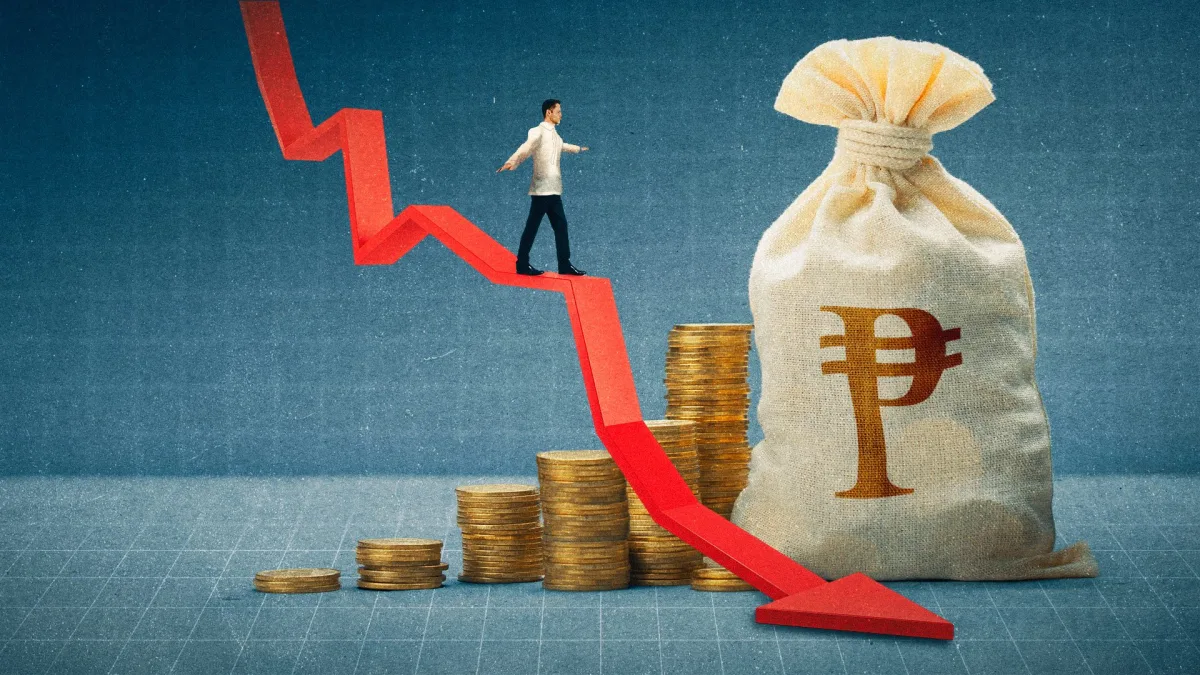
The Bangko Sentral ng Pilipinas (BSP) has quietly dropped its 2025 Financial Stability Report (FSR), and it's not the kind of bedtime reading that helps you sleep.
Prepared with four other regulators under the Financial Stability Coordination Council (FSCC), the report opens with a reassuring line from Governor Eli Remolona Jr.: the economy and financial system “remain resilient.” Banks are well-capitalized, inflation was benign, and interest rates were relatively stable. All that is true — at least for 2025.
But the FSR also names its top worry plainly: rising debt in households and firms. On the household side, the fastest-growing borrowing is the riskiest kind — unsecured consumer credit, mostly credit card debt. These loans are growing faster than incomes. For now, most borrowers are still paying on time. But “for now” is the operative phrase. Unsecured debt is the first thing that sours when jobs disappear or inflation spikes.
Then there's the corporate side. Loans from universal and commercial banks to private corporations now total roughly P7.6 trillion — more than a quarter of GDP. And a large, concentrated share of that flows to the conglomerates that dominate Philippine business: the same handful of family-controlled groups that own slices of property, power, retail, and banking all at once.
The FSR devotes an unusually candid section to what it calls “the corporate web.” Big business in the Philippines, it observes, “rarely comes in singles.” Large groups sprawl across many sectors, stitched together by common owners and dense financial links — loans, guarantees, cross-shareholdings — all financed mainly by banks. The danger is that trouble in one affiliate can spread quietly through intra-group lending before erupting noisily into the banking system.
The report walks through Philippine history to bolster this point. In the early 1980s, the collapse of a large manufacturing group with unsecured obligations helped trigger bank runs — the famous “Dewey Dee Scandal.” Years later, a property-and-finance group’s high-yield deposit schemes and fictitious loans pushed several small banks under. More recently, a major shipbuilder’s missed payments hit a cluster of lenders at once. Each crisis began in the non-financial sector and ended up testing the banks.
To its credit, the FSCC doesn't stop at describing the problem. It lays out a to-do list. It aims to operationalize a “countercyclical capital buffer” (CCyB) — a releasable cushion that banks build up when lending is hot and draw down when the economy turns. The FSCC also wants to map the conglomerates group by group and share that data across agencies. On top of that, it wants to close data gaps on non-bank financial institutions, whose links to banks regulators admit they can't yet see clearly.
Finally, it wants to finish an inter-agency crisis playbook that has been a work in progress since 2022.
But every one of these is described as something the FSCC plans to do, not something it has fully done already. These plans and buffers are useless if not deployed before the next crisis turns the corner.
The BSP has rightly identified that the Philippines’ biggest financial vulnerability is the very concentration of economic power that defines the economy: a few conglomerates heavily indebted to a banking system that lends heavily to them. Diagnosing that is the easy part. Acting on it is much harder.
The report also notes that the economy grew just 4.4% in 2025, significantly below the government’s target, dragged down by a 2.1% contraction in gross capital formation — the report’s polite term for investment drying up. The BSP responded by cutting its policy rate by a cumulative 125 basis points to 4.5%. Cheaper money props up growth, but it also makes borrowing more attractive. That is the tension running through the entire report: the same low rates keeping the economy afloat are quietly inflating the risks in the financial system.
As the June 8 magnitude-7.8 earthquake that jolted Southern Mindanao brutally illustrated, the cracks need to be sealed before the next big financial earthquake comes.