

As the 2026 FIFA World Cup kicks off across the United States, Mexico, and Canada, one of the tournament's strangest side attractions is already stirring: animals that claim to predict match results.
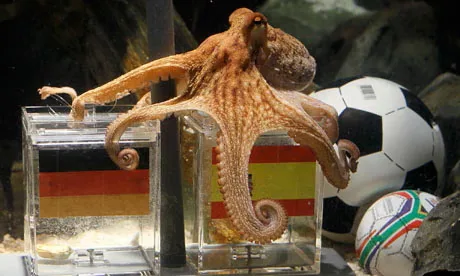
The most famous of them all remains Paul the octopus, who rose to global fame during the 2010 World Cup in South Africa. Based at an aquarium in Oberhausen, Germany, Paul achieved an estimated 87% success rate across his career. During Euro 2008 and the 2010 World Cup, he correctly predicted multiple Germany matches and famously called Spain's victory over the Netherlands in the final. His method was simple: he chose between boxes marked with competing flags, each containing food, and the box he opened first was interpreted as his prediction.
Paul's fame quickly transcended sport. Offers reportedly emerged to 'transfer' him to other zoos for large sums, and his influence even reached global politics — Iranian officials famously criticised the attention he received. He died shortly after the 2010 tournament at the age of two and a half, but his legacy lives on through statues and a Google Doodle.
At the same 2010 World Cup, Mani the parakeet — born in Malaysia but based in Singapore — also gained attention. Mani correctly picked all four quarter-final winners, including the Netherlands' victory over Brazil, before missing in the semi-finals and final, where he backed the Dutch against Spain. His rise sparked comparisons with Paul and even a symbolic 'showdown' between the two animal predictors. After his World Cup fame faded, Mani returned to working with his owner, continuing a form of 'parrot astrology' popular in Singapore.
At the 2018 World Cup in Russia, attention turned to Achilles, a deaf white cat from the Hermitage Museum in Saint Petersburg. He was designated the tournament's official feline forecaster. Achilles consistently chose Russia in his predictions — a bias his handlers attributed to his 'patriotic instincts.' Despite criticism of the concept, he became one of the tournament's most talked-about side attractions, continuing Russia's long tradition of museum cats.
At the 2022 World Cup in Qatar, Taiyo the otter in Japan gained attention after correctly predicting Japan's shock 2–1 victory over Germany. Using a simple bucket-selection method with a miniature football, Taiyo became a fan favourite for his playful accuracy.
None of these animals possess any proven predictive ability. But their place in World Cup culture endures, offering fans a light-hearted distraction from the intensity of tournament football. As the 2026 World Cup unfolds, it wouldn't be a surprise if a new generation of 'animal prophets' once again steals a share of the global spotlight.