

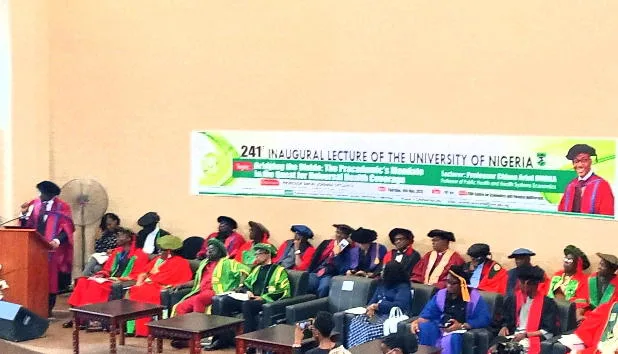
Professor Chima Onoka, a Professor of Public Health and Health Systems Economics at the University of Nigeria, has stated that research alone can't transform Nigeria's healthcare system without effective policy implementation and political engagement. Onoka made this statement while delivering the 241st Inaugural Lecture of the university titled, 'Bridging the Divide: The Pracademic's Mandate in the Quest for Universal Health Coverage.'
The professor noted that Nigeria's healthcare reforms require professionals who combine academic expertise with practical policy, advocacy, and implementation skills, describing such individuals as 'pracademics.' He emphasized that although Nigeria has sufficient research evidence for healthcare reform, progress toward Universal Health Coverage has remained slow due to political interests, bureaucracy, and poor policy execution. Nigeria's healthcare system needs professionals with a mix of academic and practical skills to drive reform.
Onoka described universal health coverage as 'a power problem,' stressing that many reforms threaten entrenched interests controlling public resources and healthcare financing. He lamented Nigeria's heavy dependence on out-of-pocket healthcare spending, revealing that citizens fund about 72 per cent of healthcare costs directly. This is a significant burden on citizens, and it's not hard to see why many Nigerians struggle to access quality healthcare. The financial strain on citizens is evident, and it's clear that the current system isn't working.
The professor estimated Nigeria's healthcare financing gap at between ₦157 trillion and ₦236 trillion over the next decade. However, he suggested that improved efficiency and better resource allocation could reduce the burden. Onoka commended reforms by the National Health Insurance Authority and praised the Basic Healthcare Provision Fund for expanding access to healthcare services. The reforms are a step in the right direction, and they've made a positive impact on the healthcare system.
'Universal health coverage is a power problem,' Onoka said, 'many reforms threaten entrenched interests controlling public resources and healthcare financing.'
Onoka further warned that without stronger financial protection mechanisms, Nigeria's healthcare system would continue to push citizens into poverty. This is a stark reality that many Nigerians face every day. The Deputy Vice-Chancellor of the University of Nigeria, Josaphat Onwumere, described the lecture as intellectually enriching and practically relevant. Onwumere's comments highlight the importance of the lecture and its relevance to Nigeria's healthcare crisis.
Nigeria's healthcare system has been plagued by funding issues for years. The lack of adequate funding has led to a shortage of medical professionals, equipment, and infrastructure. This has resulted in a significant gap in healthcare services, particularly in rural areas. The Nigerian government has made efforts to address these issues, but more needs to be done to ensure that all citizens have access to quality healthcare. The government's efforts are a good start, but they don't go far enough.
The National Health Insurance Scheme (NHIS) was established to provide health insurance coverage to all Nigerians. However, the scheme has been plagued by issues such as low enrollment rates, inadequate funding, and poor service delivery. The Basic Healthcare Provision Fund was established to provide funding for primary healthcare services. However, the fund has been criticized for being inadequate to address the healthcare needs of all Nigerians. The NHIS and the Basic Healthcare Provision Fund are essential components of Nigeria's healthcare system, but they require significant improvements.
Professor Onoka's lecture highlights the need for a multi-faceted approach to addressing Nigeria's healthcare crisis. This includes not only increasing funding for healthcare but also improving the efficiency and effectiveness of healthcare services. It also requires the involvement of all stakeholders, including healthcare professionals, policymakers, and citizens. A comprehensive approach is necessary to address the complex issues facing Nigeria's healthcare system.
Nigeria's healthcare crisis is a complex issue that requires a comprehensive approach. While research is essential in identifying solutions, it isn't enough on its own. Effective policy implementation, political engagement, and stronger financial protection mechanisms are needed to ensure that all Nigerians have access to quality healthcare. The solution to Nigeria's healthcare crisis requires a combination of research, policy implementation, and financial protection.
Key Facts
- Nigeria's healthcare financing gap is estimated at between ₦157 trillion and ₦236 trillion over the next decade.
- Citizens fund about 72 per cent of healthcare costs directly.
- The National Health Insurance Authority has made reforms to expand access to healthcare services.
- The Basic Healthcare Provision Fund has been established to provide funding for primary healthcare services.
- Professor Chima Onoka is a Professor of Public Health and Health Systems Economics at the University of Nigeria.
Nigeria's healthcare system is at a critical juncture. The government and other stakeholders must work together to address the funding issues, improve the efficiency and effectiveness of healthcare services, and ensure that all citizens have access to quality healthcare. This will require a concerted effort and a willingness to make difficult decisions. The government and stakeholders must be willing to work together to address the healthcare crisis.
Nigeria needs to increase funding for healthcare, improve the efficiency and effectiveness of healthcare services, and ensure that all citizens have access to quality healthcare. This will require a multi-faceted approach that involves all stakeholders. It will also require a commitment to addressing the underlying issues that have plagued the healthcare system for years. With the right approach, Nigeria can build a healthcare system that is equipped to meet the needs of its citizens. The government and stakeholders must be committed to making a change.
The Nigerian government has made efforts to address the healthcare crisis. However, more needs to be done to ensure that all citizens have access to quality healthcare. The government must work with other stakeholders, including healthcare professionals, policymakers, and citizens, to develop a comprehensive approach to addressing the healthcare crisis. This will require a willingness to listen to different perspectives and to make difficult decisions. The government and stakeholders must be willing to collaborate and make tough choices.
The Nigerian healthcare system is not alone in its struggles. Many countries face similar challenges in providing quality healthcare to their citizens. However, Nigeria's unique challenges require a unique approach. The government and other stakeholders must be willing to think outside the box and to develop innovative solutions to address the healthcare crisis. Nigeria's healthcare system requires a tailored approach that addresses its specific needs.
It's up to the Nigerian government and other stakeholders to ensure that all citizens have access to quality healthcare. This will require a commitment to addressing the underlying issues that have plagued the healthcare system for years. It will also require a willingness to work together and to develop a comprehensive approach to addressing the healthcare crisis. With the right approach, Nigeria can build a healthcare system that is equipped to meet the needs of its citizens. The government and stakeholders must take action to address the healthcare crisis and ensure that all citizens have access to quality healthcare.