

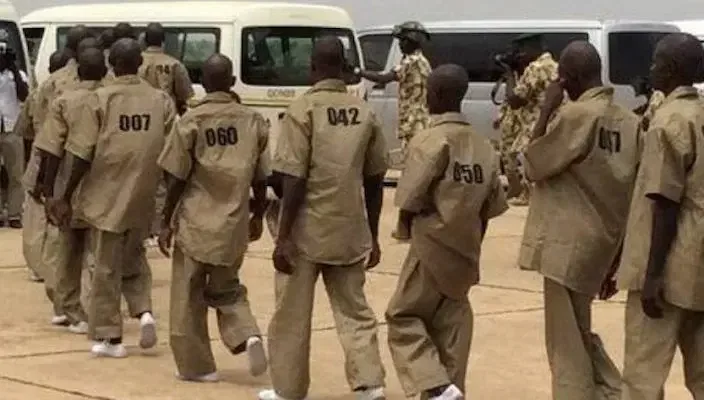
You are probably familiar with Operation Safe Corridor, a controversial programme launched in 2016 by the late President Muhammadu Buhari to rehabilitate ex-insurgents. The reintegration of deradicalised combatants would, according to Buhari, ensure sustainable peace and security in the country, and help bring the decade-long insurgency to an end.
The programme allows for the rehabilitation of 'low-risk' individuals, those coerced, abducted, or who surrendered voluntarily. They undergo a rigorous 6- to 12-month programme of psychological counselling, vocational training, and religious reorientation, with authorities claiming a recidivism rate of less than 2%. Is the policy working? The jury is still out.
Despite the programme's existence, many Nigerians are still questioning its merit. They argue that terrorists can not truly repent. And they're not alone in this thinking. Professor Benjamin Okaba, the immediate past President of the Ijaw National Congress (INC), spoke on the development. 'These are not just policy questions; they touch on the very soul of our national life, justice, and security.'
According to Okaba, the pain of terrorism is still fresh in the minds of many Nigerians. The victims and communities are traumatised, and view this as prioritizing perpetrators over those who have suffered. He, however, believes that as a scholar, he must look beyond emotion.
On June 13, 2026, Borno State Government reintegrated another batch of 720 men, 992 spouses, and 2,050 children who had repented and surrendered to the troops. These latest categories of repentant insurgents were all made to swear on oath with the Holy Quran and would be reunited into their various communities across Borno State.
The state government has so far reintegrated 9,680 repented terrorists. Many Nigerians have expressed outrage at the policy, insisting that it is a dangerous trend. They accused the government of caring more about rewarding criminals than helping victims who suffered in their hands.
Elder Joseph Ambakederimo, the Convener of the South South Reawakening Group, argued that 'any identified terrorist should be neutralized.' He believes that the government should not rest on its oars, but take the fight to the enclaves of the terrorists. 'The government should not wait until an attack occurs before reacting,' he said.
For now, the debate rages on. Will the government continue with the programme? Will it listen to the voices of the people? Only time will tell.
'These are not just policy questions; they touch on the very soul of our national life, justice, and security.'
Key Facts
- Over 124,000 insurgents have surrendered since 2023.
- The recidivism rate for those in the programme is less than 2%.
- Borno State Government has reintegrated 9,680 repented terrorists.
- The latest batch of repentant insurgents includes 720 men, 992 spouses, and 2,050 children.
- The programme was launched in 2016 by the late President Muhammadu Buhari.