

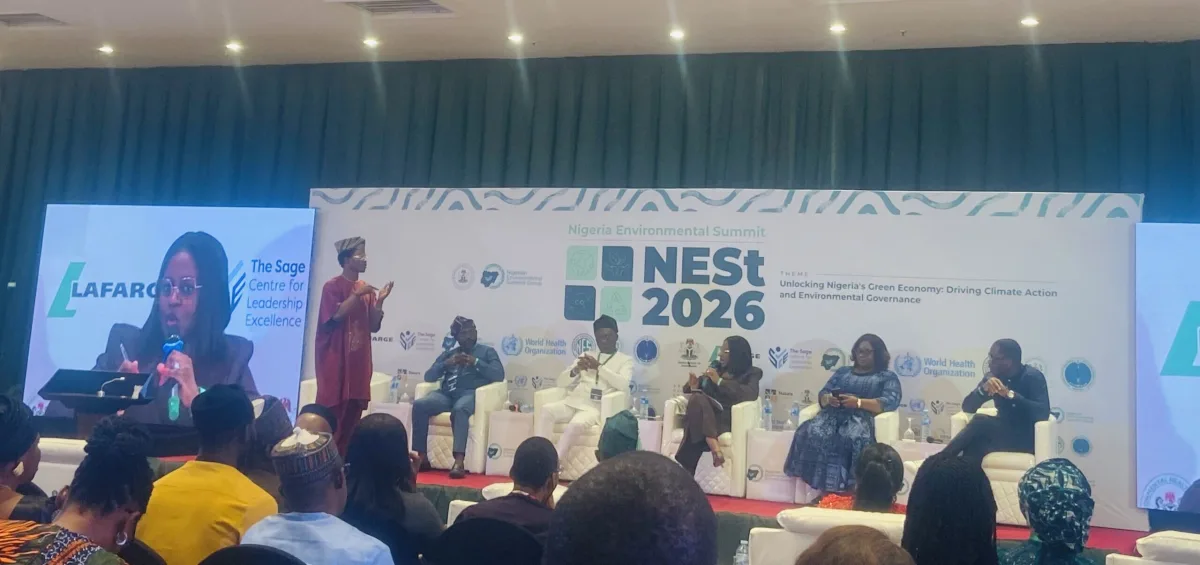
Nigeria is sitting on over $5 billion in green economy investment opportunities — but it needs to fully adopt the model to unlock them. That was the message from environmental experts, policymakers, and private-sector stakeholders at the just-concluded Nigeria Environmental Summit (NESt 2026) in Abuja.
The two-day summit, held 17–18 June, brought together government officials, investors, the private sector, academia, civil society, and international partners to discuss climate action and environmental governance. The Nigerian Environmental Summit Group (NESG) organised the event with support from the Centre for Journalism, Innovation and Development (CJID), the Pet A Plant Foundation, Alternative Bank, Lafarge Africa, the World Health Organisation (WHO), and other UN agencies.
Edwin Isotu-Edeh of the NESG told PREMIUM TIMES that the green economy could change the country's youth unemployment crisis. "It's no news that our dear nation is suffering from youth unemployment and other issues. Yet, the green economy is undoubtedly an area that can change this situation if we begin to exploit it," he said.
The summit also gave meritorious awards to individuals, businesses, and Nigerian states for their work in environmental health, sustainability, and governance.
One of the key sessions — a panel discussion themed 'Designing the cities of tomorrow: Climate-resilient infrastructure for Nigeria's growth' — focused on building smarter cities. Ronke Apata moderated the session.
Samuel Steveson, an economist with the Central Bank of Nigeria, said money alone won't achieve sustainable development. "For us to harmonise the country's fiscal policy, we need to build trust. It's trust that will make people invest and drive policy consistency," he said. He called for an inter-generational balance sheet where trust flows from now to the future, because "people won't build in an economy that will collapse."
Christopher Beka, a director at the National Environmental Standards and Regulations Enforcement Agency (NESREA), said the government already enforces safety measures for buildings — before and after construction. He stressed the need for a collaborative framework to ensure environmental impact assessments, management plans, and audits are all done.
Racheal Ezembakwe, director of health and safety at Lafarge Africa, said the private sector must include safety from the design stage. "We need to start seeing safety as part of the business, and for the construction sector, this must begin with the design and the workers," she said. She added that technology can help with risk assessment and that protecting lives is more important than comfort.
Isotu-Edeh concluded by urging Nigerians to tap into the green economy's potential. He said Nigeria has what it takes to contribute to global development and called for action to unlock the $5 billion+ investment pipelines in the sector.