

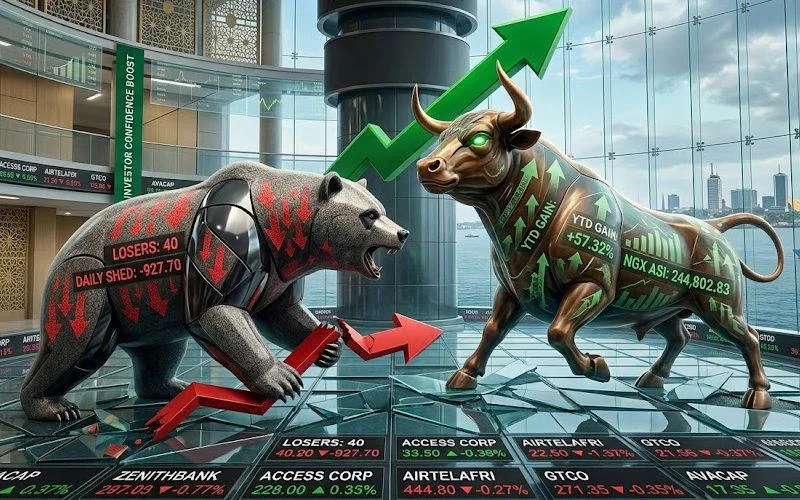
The Nigerian Exchange Ltd. (NGX) equities market on Tuesday reversed its four-session bullish run, losing N1.166 trillion in market capitalization amid sell-offs in key stocks. Market capitalization fell by 0.73 per cent from N160.421 trillion to N159.255 trillion, while the All-Share Index (ASI) shed 1,806.18 points to close at 246,723.57.
The market's year-to-date return also declined to 58.55 per cent, despite the positive breadth, which recorded 28 gainers against 27 losers. Thomas Wyatt Nigeria led the losers, declining 9.97 per cent to close at N2.89, followed by AVA Capital, which fell 9.60 per cent to N8.95. International Energy Insurance dropped 6.32 per cent to N4, while International Breweries shed 5.98 per cent to close at N11 and Guinea Insurance declined 5.13 per cent to 74k.
On the gainers' chart, UPDCREIT led with 10 per cent to close at N14.85, followed by FTN Cocoa Processors, which rose 9.88 per cent to N8.90. C&I Leasing gained 8.26 per cent to N5.90, while Sovereign Trust Insurance advanced 6.74 per cent to N1.90 and Regency Alliance Insurance rose 6.33 per cent to 84k.
Trading volume surged to 3.909 billion shares valued at N32.38 billion in 45,608 deals, compared with 1.137 billion shares worth N27.02 billion exchanged in 59,185 deals on Monday. Fortis Global Insurance dominated trading, accounting for 3.29 billion shares worth N9.58 billion, representing 84.22 per cent of total volume and 29.57 per cent of total value traded.
This crash is a huge blow to investors who were expecting a stable market. It is also a sign that the market may be heading for a downturn. The Nigerian government has been trying to boost investor confidence through various initiatives, but it seems that these efforts are yet to yield any positive results.
The NGX market crash has significant implications for the Nigerian economy. The decline in market capitalization and the shedding of points by the ASI are signs that the economy may be heading for a recession. This could lead to job losses, reduced economic growth, and lower living standards for many Nigerians.
The Nigerian government has yet to comment on the market crash, but it is expected to issue a statement in the coming days. The Central Bank of Nigeria (CBN) has also been monitoring the market closely and is expected to take action to stabilize the market.
The NGX market crash is a wake-up call for the Nigerian government to take more decisive action to boost investor confidence and stabilize the economy. The government needs to implement policies that will attract foreign investors and boost domestic investment. It also needs to improve its regulatory framework to prevent market manipulation and insider trading.
The NGX market crash has significant implications for individual investors who have invested in the market. They need to be cautious and not make any hasty decisions. They should also diversify their portfolios to minimize losses. The Nigerian Stock Exchange (NSE) has also been working to improve market liquidity and reduce volatility.
In recent years, the NGX market has been on a bull run, with the ASI rising consistently over the past four sessions. However, on Tuesday, the market reversed its gains, shedding over 1,806 points. The market capitalization also declined by 0.73 per cent.
This is a significant correction for the market and it is essential for investors to be aware of the risks involved. The NGX market is known for its volatility and investors need to be prepared for any eventuality. The Nigerian government and regulatory bodies need to take more action to stabilize the market and boost investor confidence.
The NGX market crash has significant implications for the Nigerian economy, and it is expected to affect various sectors, including real estate, manufacturing, and services. The government needs to take decisive action to prevent a worse outcome and stabilize the economy.
In a related development, the Central Bank of Nigeria (CBN) has been working to improve market liquidity and reduce volatility. The CBN has also been monitoring the market closely and is expected to take action to stabilize the market.
The NGX market crash is a reminder that the Nigerian economy is fragile and needs to be handled with care. The government needs to take proactive measures to prevent a worse outcome and stabilize the economy. The NGX market crash is a wake-up call for the Nigerian government to take more decisive action to boost investor confidence and stabilize the economy.
Key Facts
- The NGX market capitalization fell by 0.73 per cent from N160.421 trillion to N159.255 trillion.
- The All-Share Index (ASI) shed 1,806.18 points to close at 246,723.57.
- Thomas Wyatt Nigeria led the losers, declining 9.97 per cent to close at N2.89.
- UPDCREIT led with 10 per cent to close at N14.85.
- Trading volume surged to 3.909 billion shares valued at N32.38 billion in 45,608 deals.