

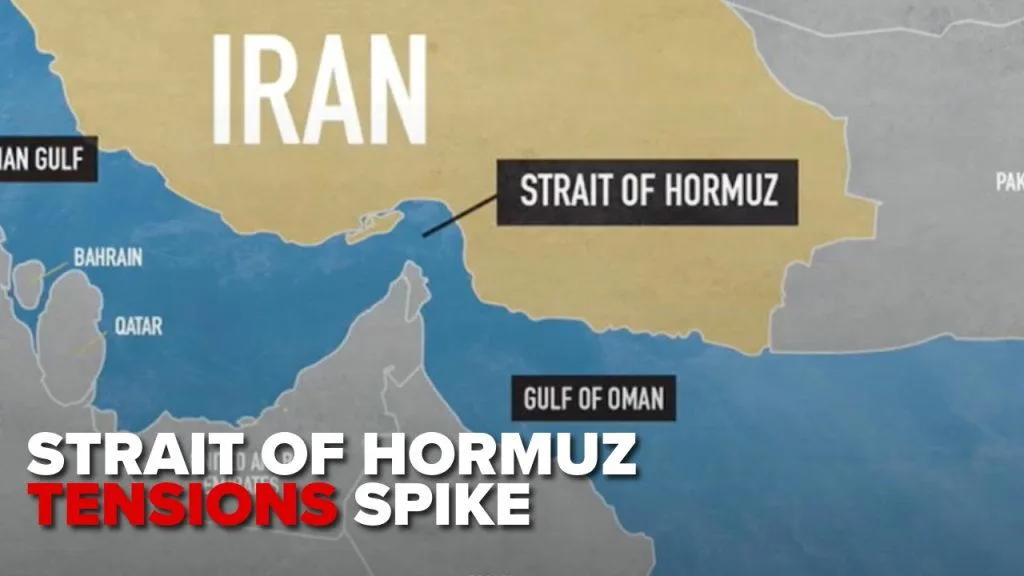
Iran's military command says it's completely closed the Strait of Hormuz and will target any vessel that tries to pass through the strategic waterway. The announcement came Thursday after Iranian forces struck two ships attempting to transit the strait, according to state media.
The Khatam al-Anbiya command, quoted by the Tasnim news agency, declared that "any vessel traffic through the Strait of Hormuz will be targeted" and that the strait is now "completely closed to all types of vessel." The Revolutionary Guards navy, speaking through state television IRIB and the Mehr agency, said "two ships attempting to illegally pass through the Strait of Hormuz were hit."
"Following repeated violations of the ceasefire by the American enemy, the Strait of Hormuz will be closed until further notice," the Guards said in a statement. "We warn that no vessel should leave its anchorage in the Persian Gulf and the Sea of Oman. Approaching the Strait of Hormuz will be considered cooperation with the enemy."
Iranian media reported explosions across the country's south near the strait, the same area where US forces had already bombarded air defence, radar, and other sites on Tuesday.
The closure comes as the United States launched a new wave of attacks against Iran on Wednesday. President Donald Trump vowed to "hit them hard" after accusing Tehran's negotiators of "playing us for suckers" during talks to end the war.
The Strait of Hormuz is a narrow channel between Iran and Oman that connects the Persian Gulf to the Gulf of Oman and the open sea. About 20% of the world's oil passes through it, making it one of the most critical chokepoints for global energy supplies. Any sustained closure would send oil prices soaring and disrupt supply chains worldwide.
For Nigeria, a major oil exporter that relies on stable global markets, a prolonged closure could mean higher revenues per barrel in the short term but also risks destabilising demand if a global recession follows. Nigerian crude grades like Bonny Light compete with Middle Eastern oil, and any disruption in Gulf supply could shift buyers toward West African barrels — at least temporarily.
This isn't the first time Iran has threatened to close the strait. During the Iran-Iraq war in the 1980s, both sides attacked oil tankers in what became known as the Tanker War. In 2019, Iran seized several tankers after a series of attacks on Gulf shipping. But a full, official closure — backed by a threat to target any vessel — is an escalation not seen in decades.
The development raises immediate questions about how the US Navy's Fifth Fleet, based in Bahrain, will respond. The US has maintained a presence in the Gulf for decades to guarantee freedom of navigation. Any attempt to enforce the closure could lead to direct military confrontation between US and Iranian forces.
"We warn that no vessel should leave its anchorage in the Persian Gulf and the Sea of Oman. Approaching the Strait of Hormuz will be considered cooperation with the enemy."
— Iran's Revolutionary Guards navy
The collapse of nuclear talks adds another layer of tension. The Trump administration withdrew from the 2015 nuclear deal in 2018 and reimposed sanctions. Iran has since enriched uranium to near weapons-grade levels, and diplomatic efforts to revive the agreement have repeatedly stalled.
Oil markets are already reacting. Brent crude jumped more than 5% in early Asian trading on Thursday, and analysts warn that prices could spike further if the closure lasts more than a few days. Global shipping insurers are expected to hike premiums for vessels in the region, and some shipping lines may reroute around Africa — adding weeks to journey times and costs.
The international community has condemned the move. The United Nations Security Council is expected to hold an emergency session, though any resolution is likely to be vetoed by Russia or China, both of which have close ties to Iran.
For now, the world waits to see whether Iran's threat is a bluff or the beginning of a wider conflict that could reshape global energy markets and security alliances.