

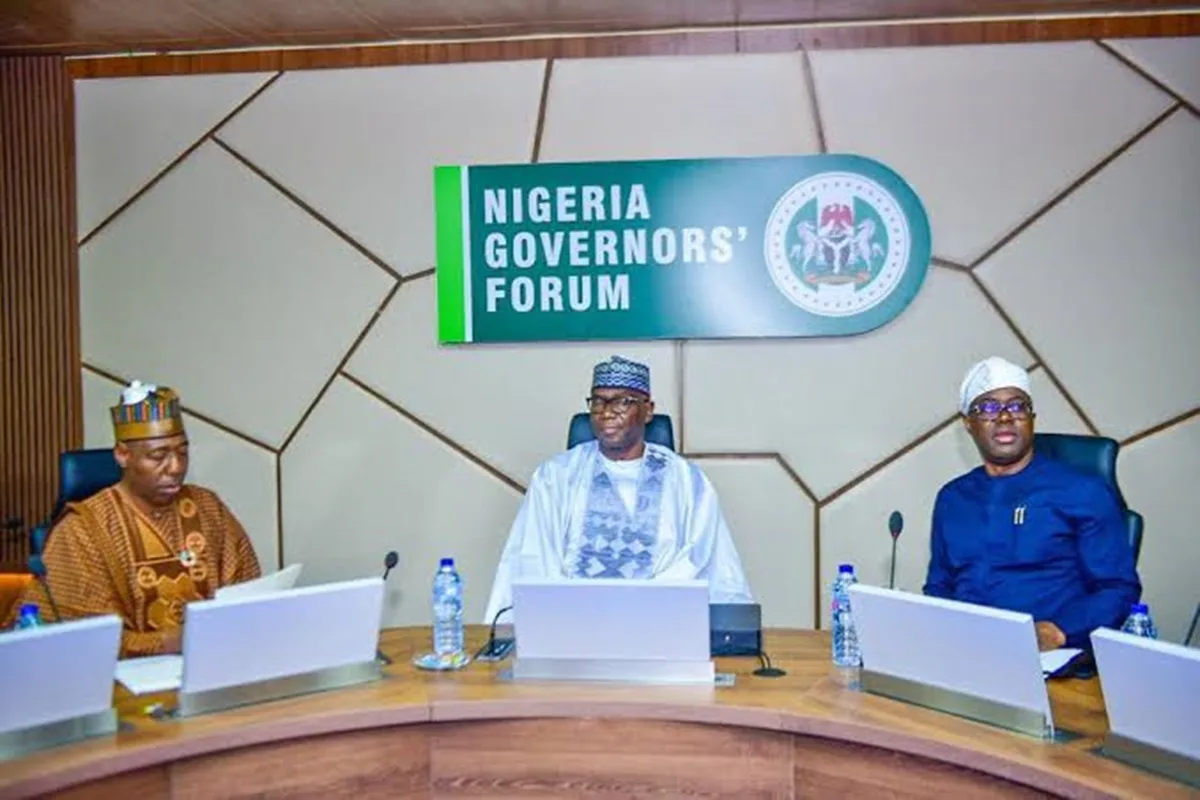
Nigeria's 36 state governors have thrown their weight behind the immediate creation of state police — but they want it done right.
At the end of a two-day meeting in Abuja on Thursday, the Nigeria Governors' Forum (NGF) issued a communiqué demanding a constitutionally sound framework for state police. It must align with federalism and protect citizens' rights.
"Governors emphasised the need for the State Police to be constitutionally sound and aligned with federalism and citizens' rights," the statement read.
The communiqué was signed by NGF Chairman and Kwara State Governor AbdulRahman AbdulRazaq.
The governors said they received updates on the state police initiative from both the Forum's secretariat and a delegation of state attorneys-general. They also held dedicated consultations with attorneys-general in their states to review proposed constitutional amendments and supporting frameworks.
This builds on work the NGF endorsed in April, when it backed its secretariat to develop a comprehensive state police blueprint. That blueprint covers governance structures, financing models, human capital standards, digital systems, and oversight mechanisms.
The push for state police has been a recurring demand from state governments, who argue that the current centralized policing system is failing to tackle insecurity across the country. Kidnappings, banditry, and farmer-herder clashes have overwhelmed the Nigeria Police Force, which reports to the federal government in Abuja.
On the power sector, the governors reaffirmed their commitment to ongoing reforms and closer collaboration with stakeholders to deliver reliable and affordable electricity.
They received a presentation on the National Solar Super-Grid Initiative — a proposal for large-scale decentralized solar generation integrated with a national high-voltage transmission network.
"The Forum noted the initiative's potential to support industrialisation, improve energy security, strengthen state electricity markets, and accelerate economic growth," the communiqué stated.
The governors expressed optimism that the project would expand electricity access while boosting state electricity markets and overall economic growth.
The Forum also supported the National Nutrition 774 Initiative, reaffirming its resolve to improve nutrition outcomes and reduce child malnutrition across Nigeria. Members noted ongoing work on the National Nutrition Bill and urged sustained engagement with stakeholders to strengthen the legal and policy framework for nutrition governance.
The governors received a briefing from the World Bank Country Office on two major programmes: the proposed Country Partnership Framework for Nigeria covering FY2026–2032, and the Nigeria Sustainable Agricultural Value-Chains for Growth (AGROW) Programme.
The AGROW programme is a results-based initiative designed to improve agricultural productivity, strengthen value chains, increase private sector participation, enhance food security, and support early childhood development.
Governors approved state-specific interventions under the programmes and stressed the importance of better coordination across health, nutrition, education, water and sanitation, social protection, and family support sectors. They pledged continued collaboration with the federal government, the World Bank, and other partners to ensure successful implementation and tangible benefits for participating states.
The resolutions from the Abuja meeting underscore the governors' determination to advance security sector reform, sustainable energy solutions, and improved nutrition outcomes for Nigerians.