

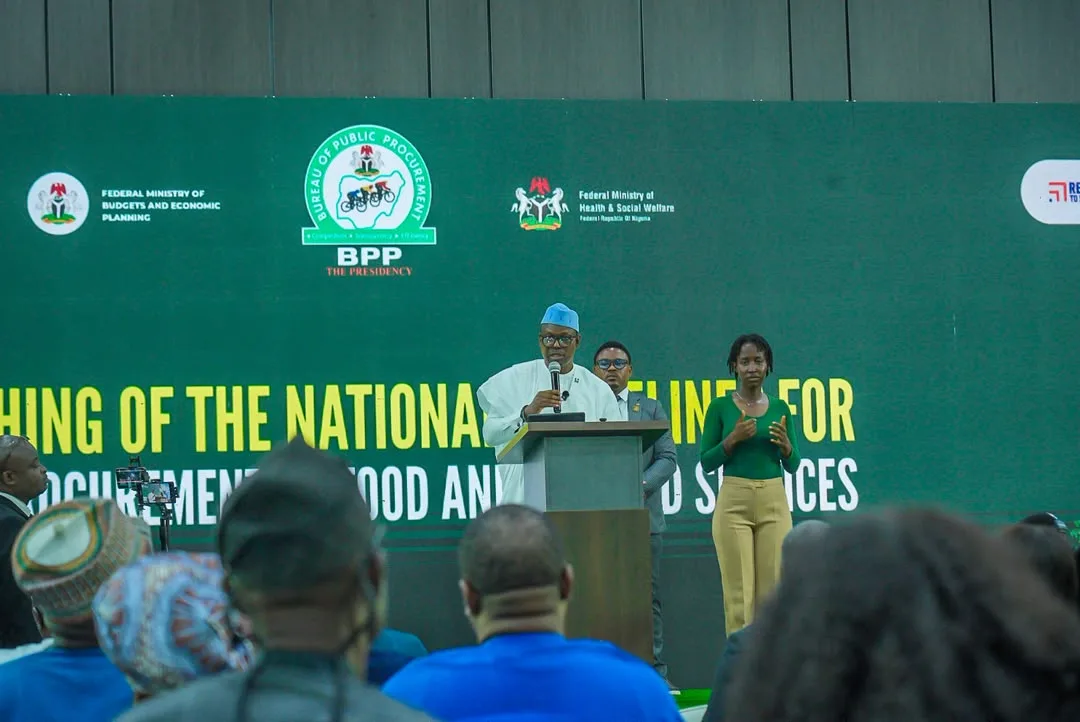
‘When the government demands healthier, safer and more nutritious food, it creates incentives for the entire food system to innovate, improve quality and align with higher public health standards.’ — Minister of State for Health and Social Welfare, Iziaq Salako.
The federal government has launched the National Guidelines for Public Procurement of Food and Related Services to tackle unhealthy diets and reduce the growing burden of non-communicable diseases in Nigeria.
The guidelines, unveiled on Monday in Abuja, are expected to influence food served in public institutions such as schools, hospitals, correctional centres, and military establishments, by setting evidence-based standards on nutrition, food safety, and quality.
Delivering his keynote address at the launch, Minister of State for Health and Social Welfare, Iziaq Salako, said the initiative marks a shift from viewing public procurement as a routine administrative process to using it as a strategic tool to improve public health and national development.
The minister revealed that unhealthy diets contribute to about 7.2 million deaths globally every year, driven largely by excessive consumption of salt, sugar, and unhealthy fats as well as inadequate intake of fruits, vegetables, and whole grains.
According to him, the guidelines establish limits on sodium, sugar, and unhealthy fats in foods procured by public institutions while encouraging balanced and nutritious diets.
Mr. Salako noted that the average Nigerian adult consumes between 3.9 grammes and 4.9 grammes of sodium daily, almost double the World Health Organisation’s recommended limit of 2 grammes.
The minister also highlighted the country’s persistent nutrition challenges, noting that malnutrition remains a direct or underlying cause of nearly half of the deaths among children under five years.
He said the Nigeria Mini Demographic and Health Survey found that about four in every 10 Nigerian children under five are stunted, while nearly two million children suffer severe acute malnutrition annually.
The guidelines, he noted, are part of efforts to improve public health and national development, and will complement existing national policies, including the National Guideline for Sodium Reduction, the Trans Fat Regulation, and the 2023 National Policy on Food Safety and Quality.
Mr. Salako stressed that the success of the guidelines would depend on effective implementation rather than their launch and urged procurement and accounting officers across government institutions to ensure compliance.
The Federal Ministry of Health and Social Welfare will continue to promote disease prevention through healthier public policies as part of efforts to achieve universal health coverage.
The launch of the guidelines was themed ‘Public Procurement of Food: Promoting a Culture of National Wellness Through the Food Value Chain.’
And as the federal government takes steps to promote healthy diets among Nigerians, it is also a wake-up call for Nigerians to take responsibility for their health by making informed choices about the food they eat.
Key Facts
- The federal government has launched the National Guidelines for Public Procurement of Food and Related Services.
- The guidelines will influence food served in public institutions across the country.
- The guidelines establish limits on sodium, sugar, and unhealthy fats in foods procured by public institutions.
- The average Nigerian adult consumes between 3.9 grammes and 4.9 grammes of sodium daily, almost double the World Health Organisation’s recommended limit of 2 grammes.
- Malnutrition remains a direct or underlying cause of nearly half of the deaths among children under five years in Nigeria.