

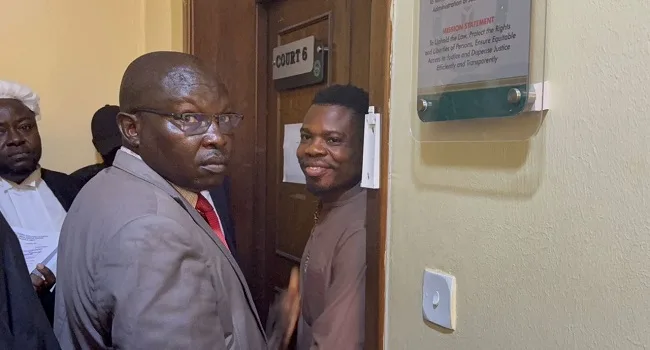
A Federal High Court in Abuja has granted bail to activist and social media commentator, Justice Chidiebere, popularly known as Justice Crack, in the sum of five million naira. This decision was made by Justice Joyce Abdulmalik, who ordered that the bail bond must be backed by one surety in like sum.
The court held that the proposed surety must reside within the jurisdiction of the court at a fixed address for at least four years. They must also deposit proof of residence, either through a tenancy agreement or certificate of occupancy, at the court registry. The surety is also required to be a federal civil servant not below Grade Level 15, with evidence of at least three months’ salary. They need a letter of authentication from the immediate head of department, as well as proof of pensionable employment.
The court further directed that the surety must depose to an affidavit of means and submit a recent passport photograph. The defendant is to deposit his international passport with the court. Earlier, the prosecution counsel informed the court that the prosecution was ready to commence trial.
The first prosecution witness, identified as Uruntu Douglas, a DSS operative, told the court that he came to know the defendant during investigations after he was transferred to the DSS from the Nigerian Army Intelligence Corps. The witness said the defendant voluntarily made an extra-judicial statement, which was recorded in the presence of his lawyers.
According to the witness, soldiers had sent pictures to the defendant, who allegedly made videos from the images and posted them on social media without confirming the authenticity of the materials from military sources. He further told the court that investigators extracted data from the defendant’s phone, including videos allegedly posted online. They also extracted conversations between the defendant and some soldiers, chats with his godfather allegedly discussing protests, as well as excerpts from his social media pages.
The witness added that a certificate of compliance was issued and signed by a superior officer after the forensic process was concluded. During proceedings, defence counsel, Sam Amadi, informed the court that the defence hadn't been served with the investigation report and other documents sought to be tendered by the prosecution.
The prosecution, however, described the failure as an oversight and apologised before the court. Justice Joyce Abdulmalik subsequently admitted the DSS investigation report as Exhibit A. The prosecution also tendered an iPhone allegedly recovered from the defendant, a flash drive said to contain videos posted on social media platforms, conversations extracted from the device, and the certificate of compliance.
The defence objected to the admissibility of the flash drive, arguing that its contents hadn't been described or played before the court. Justice Joyce Abdulmalik subsequently adjourned the case until May 25 for continuation of trial, with the first prosecution witness yet to be discharged.
The bail condition for Justice Crack is quite stringent, indicating the seriousness with which the court is treating the case. It's clear that the court is taking the case seriously and won't tolerate any attempts to interfere with the trial.
Justice Chidiebere, also known as Justice Crack, is a social media commentator known for his outspoken views on various issues. His arrest and subsequent bail have sparked interest in the case, with many waiting to see how it unfolds. He's known for speaking his mind, and it's likely that he won't back down now.
The case against Justice Crack is expected to continue on May 25, with the prosecution expected to present more evidence against him. The defence, on the other hand, will have the opportunity to respond to the allegations and defend their client. They'll need to be prepared to address all the evidence presented by the prosecution.
The bail granted to Justice Crack is a significant development in the case, as it allows him to remain free while the trial continues. However, the stringent conditions attached to the bail indicate that the court is taking the case seriously and is determined to ensure that Justice Crack doesn't flee or interfere with the trial. He won't be able to leave the country, and he'll need to be careful not to do anything that could be seen as interfering with the trial.
The trial of Justice Crack is a high-profile case, given his status as a social media commentator. The case has sparked interest in many, with some seeing it as a test of the freedom of speech in the country. It's a complex issue, and it's not clear how the court will rule.
The key facts in the case are: the bail granted to Justice Crack is in the sum of five million naira, the bail bond must be backed by one surety in like sum, the surety must be a federal civil servant not below Grade Level 15, the defendant must deposit his international passport with the court, and the case is adjourned until May 25 for continuation of trial. These facts indicate that the court is taking the case seriously and won't tolerate any attempts to interfere with the trial.
As the case against Justice Crack continues, it's expected that more details will emerge about the allegations against him. The trial is likely to be closely watched, given the interest it has generated so far. Many people are waiting to see how the case unfolds, and it's likely that there will be a lot of debate about the freedom of speech.
The decision to grant Justice Crack bail is a significant one, as it allows him to prepare his defence while awaiting the continuation of the trial. However, the stringent conditions attached to the bail indicate that the court is taking the case seriously and is determined to ensure that Justice Crack doesn't flee or interfere with the trial. He'll need to be careful to comply with all the conditions of his bail.
The trial of Justice Crack is a complex one, with many factors at play. As the case continues, it's expected that more details will emerge about the allegations against him and the evidence presented by the prosecution. The court will need to carefully consider all the evidence and make a decision based on the law.
In the meantime, Justice Crack remains free on bail, awaiting the continuation of his trial. The case is expected to generate more interest in the coming days, as the prosecution and defence present their arguments. It's likely that there will be a lot of discussion about the case, and it's not clear how it will all play out.
The court's decision to grant Justice Crack bail is a significant development in the case, and it will be interesting to see how the trial unfolds in the coming days. As more details emerge, it's expected that the case will continue to generate interest and spark debate about the freedom of speech in the country. The case is complex, and it's not clear what the outcome will be.
The case against Justice Crack is a reminder that the freedom of speech is not absolute, and that there are consequences for making statements that are deemed to be offensive or inflammatory. As the trial continues, it's expected that the court will carefully consider the evidence presented and make a decision based on the law. The court won't tolerate any attempts to interfere with the trial, and Justice Crack will need to be careful to comply with all the conditions of his bail.
The trial of Justice Crack is a complex and high-profile case, with many factors at play. As the case continues, it's expected that more details will emerge about the allegations against him and the evidence presented by the prosecution. The court's decision to grant Justice Crack bail is a significant development in the case, and it will be interesting to see how the trial unfolds in the coming days. The case will likely generate a lot of interest and debate, and it's not clear what the outcome will be.