

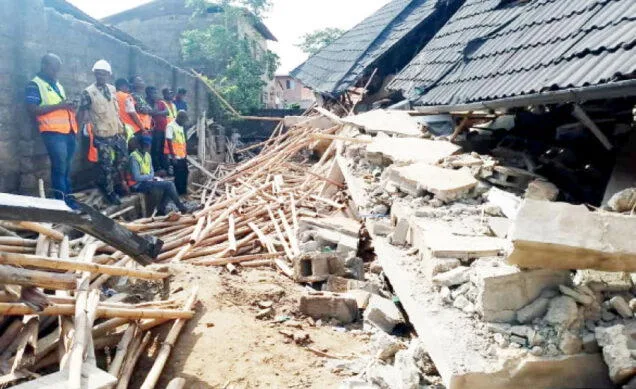
The single sharpest fact in one or two punchy sentences. Who did what, where, when, and why it matters. Between January 2020 and June 2026, Nigeria recorded dozens of building collapses that killed hundreds and injured many more.
Nationally, more than 650 collapses have killed over 1,600 people since 1974, according to figures the Federal Government cited last month. Lagos, where rapid urban growth and chronic flooding concentrate risk, accounts for over half of all recorded incidents. High-profile collapses there in 2021, 2022, and 2024 claimed dozens of lives apiece and destroyed livelihoods. Nationwide, incidents continue to climb: residential blocks, commercial properties, and even schools have given way, often during heavy rains or while occupants slept.
The failures continue despite the existence of regulatory agencies. The Standards Organisation of Nigeria (SON), state works ministries, and local councils already hold mandates to regulate and police building materials and sites. What has failed is enforcement: under-funded agencies, inspectors without leverage against politically connected developers, and penalties too weak to change behaviour.
Reform must start there. Two measures matter most. First, criminal and civil liability must extend to manufacturers, suppliers, and complicit professionals where negligence leads to collapse, with State Houses of Assembly legislating penalties stiff enough to deter, alongside whistleblower protection.
Second, SON must move from paper standards to street-level enforcement: mandatory certification for block producers, regular market sampling and lab testing, and tighter import checks. Supporting this, local councils should license and inspect block-moulding sites, publishing lists of certified producers and revoking licenses for repeat offenders.
Approval processes must include mandatory on-site inspection at foundation, lintel, and roof stages, not just at submission – with inspectors trained, equipped, and rotated to reduce corruption. Digital permit platforms publishing inspection status would add pressure that paper files cannot.
Professional bodies (COREN, ARCON, the Nigerian Institution of Building, NIB) should broaden certification and discipline members who cut corners, while owners and developers must insist on certified materials and licensed builders. Also, flood-prone and waterlogged areas must be mapped, zoned, and regulated, with urban planning mandating drainage, soil stabilisation, and pilings where required.
None of this is new advice. What is missing is the political will to enforce rules that already exist. Every collapse averted henceforth is a family that does not join the mounting toll.
Key Facts
- Over 650 building collapses recorded in Nigeria since 1974
- Over 1,600 people killed in these collapses
- Lagos accounts for over half of all recorded incidents
- High-profile collapses in 2021, 2022, and 2024 claimed dozens of lives apiece
- National incidents continue to climb: residential blocks, commercial properties, and even schools have given way
A 2003 report by the Lagos State Government noted that over 70% of buildings in Lagos were constructed using poorly made blocks, which were often produced by unlicensed manufacturers. The report also highlighted the lack of effective regulation and enforcement, leaving many builders to prioritize cost over safety.
Experts say that the issue is not just with the quality of building materials but also with the enforcement of regulations. The Standards Organisation of Nigeria (SON) is responsible for regulating building materials, but it lacks the resources and capacity to effectively enforce its standards. The agency has been criticised for its slow response to complaints and its failure to prosecute manufacturers who produce substandard materials.
In recent years, there have been calls for the government to strengthen regulations and enforcement to prevent building collapses. The Lagos State Government has launched several initiatives to improve building safety, including the creation of a database of licensed builders and the establishment of a special task force to monitor and enforce building regulations.
However, experts say that more needs to be done to address the root causes of the problem. They recommend that the government should increase funding for the Standards Organisation of Nigeria (SON) to enable it to effectively enforce its standards. They also suggest that the government should introduce stricter penalties for manufacturers who produce substandard materials and for builders who violate building regulations.
The government has yet to take any decisive action to address the issue, and experts warn that the problem will continue to persist unless there is a fundamental change in the way the industry is regulated and enforced.
The Nigerian government has been aware of the problem of building collapses for decades. In 1974, it established the Standards Organisation of Nigeria (SON) to regulate building materials. However, the agency has struggled to effectively enforce its standards due to a lack of resources and capacity.
In recent years, the government has taken steps to address the problem. In 2020, it launched a national building code that sets standards for building design, construction, and maintenance. However, the code has yet to be effectively enforced, and many builders continue to prioritise cost over safety.
The government has also established a special task force to monitor and enforce building regulations. However, the task force lacks the resources and capacity to effectively do its job, and many builders continue to flout the rules.
Despite the efforts of the government, the problem of building collapses continues to persist. Experts say that the issue is not just with the quality of building materials but also with the enforcement of regulations. The Standards Organisation of Nigeria (SON) is responsible for regulating building materials, but it lacks the resources and capacity to effectively enforce its standards.
The agency has been criticised for its slow response to complaints and its failure to prosecute manufacturers who produce substandard materials. Experts say that more needs to be done to address the root causes of the problem.
They recommend that the government should increase funding for the Standards Organisation of Nigeria (SON) to enable it to effectively enforce its standards. They also suggest that the government should introduce stricter penalties for manufacturers who produce substandard materials and for builders who violate building regulations.
The government has yet to take any decisive action to address the issue, and experts warn that the problem will continue to persist unless there is a fundamental change in the way the industry is regulated and enforced.