

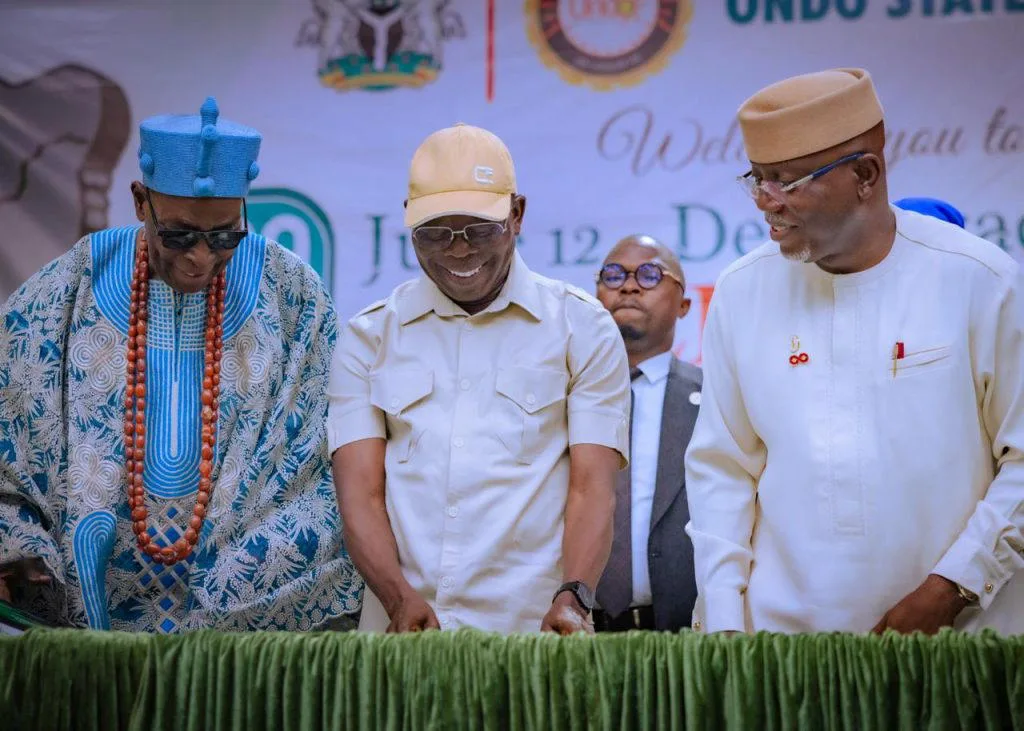
Late military ruler Sani Abacha was ready to offer M.K.O. Abiola anything he wanted — except one thing: the right to call himself President of Nigeria. That's according to former Edo State governor and senator Adams Oshiomhole, who spoke at a June 12 Democracy Day lecture in Akure, Ondo State capital.
Oshiomhole was part of a Nigeria Labour Congress delegation that met Abacha in Abuja after the annulment of the June 12, 1993 election. He said Abacha told them: "I was ready to tolerate anything and do anything for MKO Abiola. The one thing he wasn't ready to tolerate was the idea that Abiola had proclaimed himself President of Nigeria."
Despite pressure from government officials and intermediaries, Abiola refused to renounce the mandate. Oshiomhole said Abiola told those who sent them: "He was elected President of Nigeria and wouldn't sell the mandate entrusted to him by the Nigerian people."
Oshiomhole described Abiola's stance as an act of courage, patriotism and selflessness. He urged young Nigerians to learn from June 12, calling Abiola a symbol of national unity whose victory crossed ethnic and religious lines.
The lecture, titled "June 12 and Beyond: Reflecting on the Progress of Democracy and Security Concerns," also covered state police. Oshiomhole said President Bola Tinubu is pushing for constitutional amendments to create state police.
"The President is very determined that we should accelerate action to get the state police amendment through. He has told us point blank to get it done, but he can't decree it. The National Assembly must pass it and it must be approved by at least two-thirds of the state assemblies before it becomes part of the Constitution," Oshiomhole said.
If passed, the amendment would let states appoint their own police commissioners and improve grassroots security.
Ondo State Governor Lucky Aiyedatiwa called the June 12 election one of Nigeria's defining democratic moments. He said democracy isn't a destination but a continuous journey, and that true democracy is measured by good governance, not just elections.
Aiyedatiwa stressed that democracy needs peace and security. He warned that insecurity weakens democratic institutions, discourages civic participation, and erodes public trust. He backed Tinubu's security efforts under the Renewed Hope Agenda and supported decentralised policing.
On state police, Aiyedatiwa declared Ondo State is ready. "For us in Ondo State, we've been ready for a long time. The structures established under my predecessor, late Rotimi Akeredolu, have been strengthened. We have the personnel and the framework. What remains is approval for more sophisticated equipment and weapons to enhance effectiveness," he said.
Chairman of the event, Olu Falae, recalled the sacrifices of the June 12 struggle. He said the election was a watershed in Nigeria's political development. Nigerians voted overwhelmingly for Abiola in what was widely seen as a credible election before its annulment sparked resistance and the formation of the National Democratic Coalition.
Falae warned against any return to military rule. He said the pro-democracy struggle involved detention, exile and loss of lives, but eventually led to Nigeria's current democracy.