

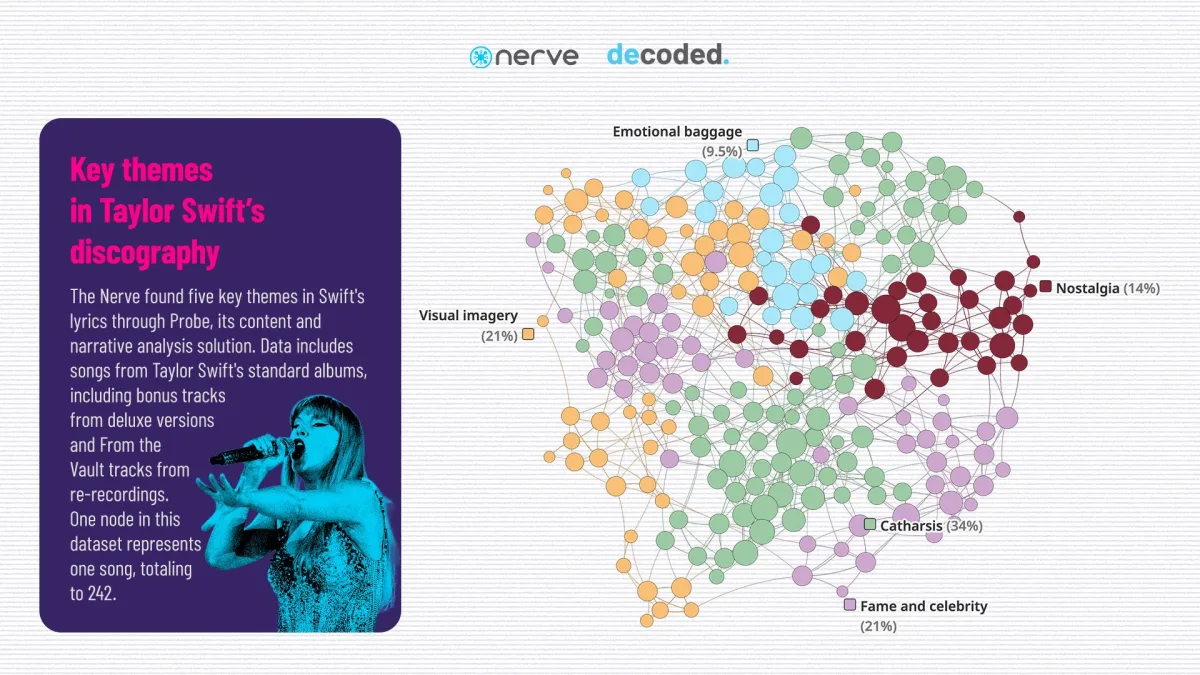
Taylor Swift is being inducted into the Songwriters Hall of Fame today, June 11, and data consultancy The Nerve has broken down her 20-year career to show exactly how her songwriting has changed.
They analyzed 242 songs from her 12 standard albums — including bonus tracks and "From the Vault" recordings — using their content analysis tool called Probe. What they found is a map of an artist who went from a heart-on-sleeve teenager to a pop superstar wrestling with fame itself.
The biggest theme across her entire catalogue? Catharsis. It makes up about 34% of her songwriting. That's the raw release of emotion — anger, heartbreak, joy — aimed at reaching some kind of peace. This was most obvious in her early albums: her 2006 self-titled debut, 2008's Fearless, and 2010's Speak Now.
Back then, Swift sounded like she was reading straight from her diary. Take "Dear John," a song about a much older lover. She sings, "Don't you think I was too young to be played by your dark, twisted games?" No fancy metaphors. Just pure feeling.
But as she grew older and her career exploded, her themes shifted. By 2012's Red and 2014's 1989, Swift had fully moved from country to pop. She started working with hitmakers Max Martin and Shellback, who know how to craft perfect pop songs. But she didn't want to lose her storytelling. So she turned to nostalgia — which makes up 14% of her lyrics.
Music critics call this "hauntology" — when an artist pulls from cultural memories to trigger a feeling of the past. Swift did this visually and lyrically. Red's album cover was directly inspired by Joni Mitchell's Blue. 1989 was drenched in 1980s imagery, with Polaroid photos and references to wired telephones and "James Dean daydreams." Her song "All Too Well" became famous for its nostalgic, detailed storytelling — so much so that she later released a 10-minute version.
Then came 2017's reputation. This was the album where Swift stopped just writing about love and started writing about being a celebrity. Fame and celebrity themes jumped from 7% of her debut to 19% on 1989, and then exploded on reputation — where it makes up 21% of her songwriting.
The context matters. Before reputation, Swift had gone through a very public hate train. She was called a serial dater. She was slut-shamed. She was everywhere, and people were tired of her. She "disappeared for a year." When she came back, she wrote an album where the most common word wasn't "love" — it was "time." She sang about breaking hearts, rising from the dead, and the best and worst of times. reputation was her way of killing the perfect image the world had built for her.
"I rose up from the dead; I do it all the time."
The analysis excluded EPs, movie soundtracks, unreleased tracks, and features. Remixes and acoustic versions were also removed to avoid duplicates. So these 242 songs represent the core of what Swift has chosen to put on albums.
Swift's induction into the Songwriters Hall of Fame isn't just about her hits. It's about how she turned her life into a mirror for millions of fans — first through teenage catharsis, then through nostalgic storytelling, and finally through a raw look at fame itself.