

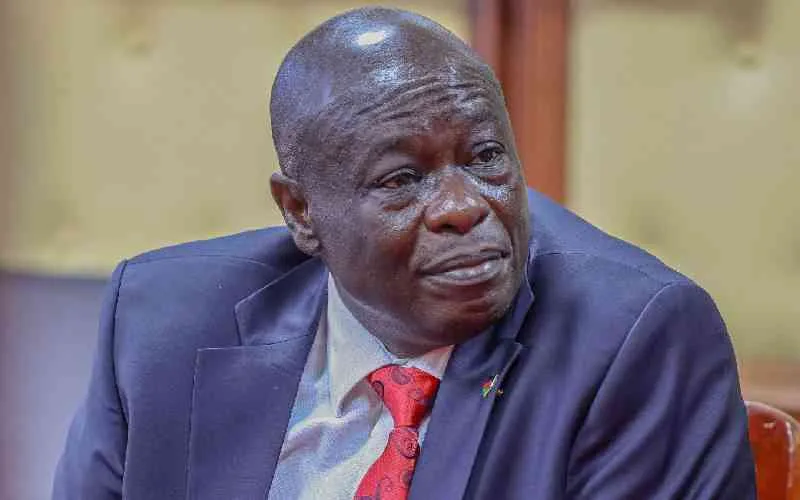
When High Court Judges Eric Ogola, Anthony Mrima, and Freda Mugambi finished reading their 350-page judgment on Wednesday, the verdict was clear: former Deputy President Rigathi Gachagua's impeachment stands. But tucked inside that massive document was a Sh50 million compensation award for violation of his right to a fair hearing — and that's where the trouble began.
The decision has united an unlikely coalition of Kenya's legal heavyweights — all of them furious. Former Chief Justice Willy Mutunga, Law Society of Kenya (LSK) presidents Nelson Havi, Eric Theuri, and Faith Odhiambo, senior lawyer Ahmednasir Abdullahi, and advocates Donald Kipkorir, Peter Wanyama, Waikwa Wanyoike, Evance Ndong, and Joshua Malidzo all expressed dissatisfaction with how the three judges settled the case.
Their gripe? If Gachagua's right to a fair hearing was violated, they argue, the impeachment itself should have been nullified — not just compensated with cash.
The Sh50 million award is particularly galling to critics. It's a significant sum, but it doesn't change the political reality: Gachagua is out of office, and President William Ruto's administration continues without him. The former DP, who was impeached by the National Assembly and Senate in October 2024 on charges including gross violation of the constitution, incitement, and undermining the government, had challenged his removal in court.
The High Court bench, after months of deliberation, chose a middle path that seems to satisfy no one. They validated the impeachment process in principle but acknowledged that Gachagua's fair hearing rights were breached somewhere along the way. The result is a ruling that keeps Gachagua out of power while handing his lawyers a moral victory — and a cheque.
This isn't the first time Kenya's judiciary has faced backlash over a high-profile political case. In 2017, the Supreme Court nullified President Uhuru Kenyatta's re-election, a decision that drew both praise and condemnation. But this time, the criticism is coming from the legal community itself, not just politicians.
Ahmednasir Abdullahi, a prominent lawyer and frequent government critic, didn't hold back. He described the judgment as "jurisprudential chaos" and questioned how a court could simultaneously uphold an impeachment and find its process flawed. Faith Odhiambo, the current LSK president, called for a review of the reasoning, warning that the ruling sets a dangerous precedent for future impeachment cases.
For Gachagua, the Sh50 million is cold comfort. He remains barred from holding public office for ten years — the constitutional penalty for an impeached deputy president. His political career, at least for now, is finished. But the legal battle may not be over. His lawyers are expected to appeal the decision to the Court of Appeal, arguing that the High Court contradicted itself.
The case has also reignited debates about the impeachment process itself. Critics say the National Assembly and Senate, both dominated by Ruto's Kenya Kwanza coalition, rushed the proceedings without giving Gachagua adequate time to defend himself. The court's Sh50 million award seems to confirm at least part of that complaint.
What happens next is uncertain. If the Court of Appeal overturns the High Court's ruling, Gachagua could be reinstated — a political earthquake. But if the appeal fails, the Sh50 million payout becomes a footnote in a case that has exposed deep divisions between Kenya's judiciary and its legal elite.
For now, the judges' 350-page judgment sits as a curious artifact: a document that says Gachagua was wronged, but not wrong enough to keep his job. And Kenya's top lawyers aren't letting them forget it.