

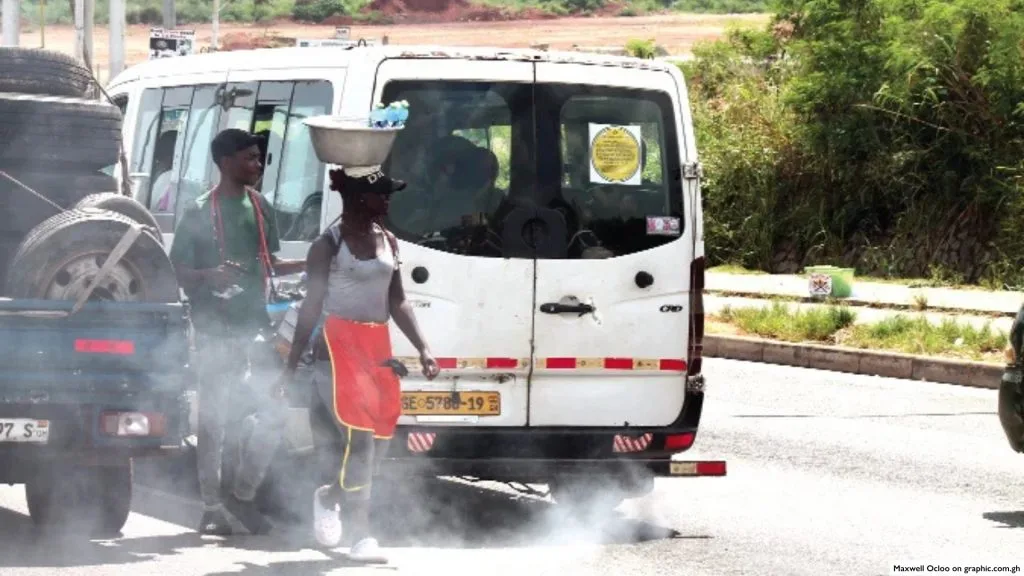
The air you breathe in Accra might be slowly killing you. New data from the WHO, UNICEF, and the State of Global Air report confirms that air pollution is now the country's second-leading risk factor for death – only high blood pressure is deadlier.
Vehicle fumes are the main culprit. The Environmental Protection Agency (EPA) estimates that PM2.5 – tiny particles that lodge deep in your lungs – causes about 2,800 deaths every year just in the Greater Accra Metropolitan Area. The main source? Cars and trotros stuck in traffic.
Nationally, the picture is even grimmer. Air pollution is linked to between 28,000 and 32,000 deaths each year – that's roughly 14 percent of all deaths in Ghana. Health experts say it's driving up strokes, heart disease, lung cancer, and chronic lung problems.
Here are the numbers: air pollution is tied to 39 percent of stroke deaths, 33 percent of lung cancer deaths, 66 percent of Chronic Obstructive Pulmonary Disease (COPD) deaths, and a third of deaths from lower respiratory infections and neonatal causes.
Children are paying the heaviest price. In 2023 alone, about 5,900 children under 20 died from air pollution-related illnesses. That's 16 children every single day.
Why is this happening? Ghana's vehicle fleet is old and dirty. As of 2022, there were an estimated 3.2 million vehicles on the roads, and more than 95 percent are classified as old and highly polluting. Many are imported used cars with diesel engines, whose exhaust has been classified as carcinogenic – a direct cause of lung cancer.
Ghana signed the Paris Agreement in 2015 and has a National Climate Change Policy dating back to 2013. That policy talks about building a climate-resilient, low-carbon economy. But when it comes to actually cutting vehicle pollution, there's been almost no action.
Right now, there is no national policy to manage vehicle pollution. The EPA and Ghana Standards Authority have set a standard for acceptable particle emissions from each vehicle, but enforcement is weak. The Driver and Vehicle Licensing Authority (DVLA) and EPA haven't released any data on how they plan to tackle the problem – or even commented on the crisis.
Meanwhile, the deaths keep piling up. The working class breathes in fumes on the way to work. Children play in streets thick with exhaust. And the authorities have yet to show they take this seriously.
Key Facts
- Air pollution is Ghana's #2 killer after high blood pressure
- 28,000–32,000 annual deaths (14% of all deaths)
- 2,800 deaths/year in Greater Accra from PM2.5 alone
- 5,900 children under 20 died from air pollution in 2023
- 95% of 3.2 million vehicles are old and highly polluting
- No national vehicle pollution policy exists