

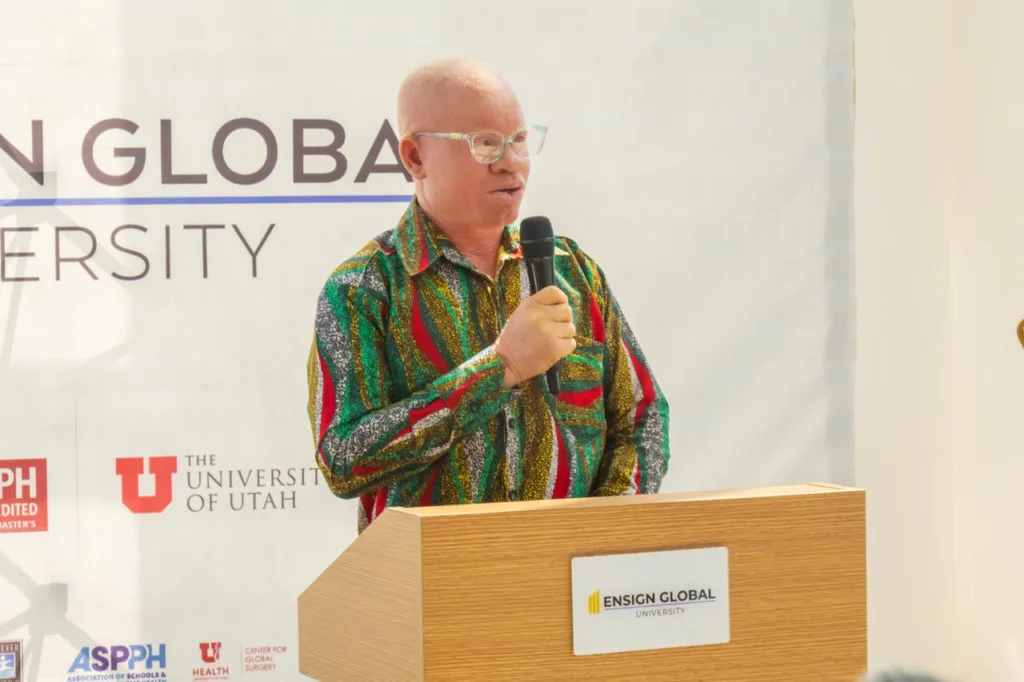
On June 12, a day before the global observance, Ensign Global University and Engage Now Africa gathered stakeholders at the CLIP Foyer in Kpong to mark International Albinism Awareness Day 2026. Their message was blunt: Ghana is still failing persons with albinism.
Dr. Sandra Boatemaa Kushitor dropped the headline finding from a three-year study: persons with albinism are discriminated against because of their skin colour. Not because of ability, not because of education — because of how they look. The research covered healthcare, education, and livelihood access.
President of Ensign Global University, Dr Karl Manlan Alder, said the institution is committed to research and partnerships that reduce barriers. “On this International Albinism Awareness Day, we affirm our commitment to ensuring that people with albinism have opportunities for experiencing good health, can access education, and are able to pursue opportunity pathways,” he said.
Chairman of the occasion, Prof. Stephen Manortey, called for everyday kindness. “Persons with albinism deserve our respect, protection, and everyday acts of kindness, whether through accessible healthcare, inclusive education and employment opportunities, or simple gestures of friendship and support,” he said. He urged Ghanaians to challenge harmful myths and discrimination.
Cecilia Amankwah, Country Director of Engage Now Africa, said the challenges aren't inevitable. “These challenges aren't inevitable; they're shaped by systems, attitudes, and gaps that we collectively have the responsibility to address,” she said. Her organisation has been working on albinism advocacy for years.
The Eastern Regional Director of Social Welfare, Isaac Asante, stressed that inclusion must go beyond symbolic recognition. “Celebrating all skin tones means more than symbolic recognition. It requires deliberate action,” he said. He called for inclusive education, improved healthcare access, stronger social protection, and enforcement of laws against discrimination and violence.
Newton K. Katseku, Director of the Ghana Association of Persons with Albinism, appealed for stronger support systems. “We therefore call on all stakeholders to strengthen efforts to ensure equal opportunities, access to essential services such as sunscreen and low-vision support, and inclusive environments that enable persons with albinism to participate fully in society,” he said.
Persons with albinism in Ghana face a double burden: social stigma and a real health crisis. Their lack of melanin makes them highly vulnerable to skin cancer, yet sunscreen and regular dermatological care remain out of reach for many. Visual impairment is common, but low-vision aids are rarely available in public schools or workplaces.
The event also featured technical presentations, stakeholder dialogue sessions, advocacy discussions, and the distribution of free sunscreen samples to persons with albinism by IBA Beauty. It was a small step, but participants made clear that systemic change — not charity — is what's needed.
International Albinism Awareness Day, observed annually on June 13, was established by the United Nations to spotlight the challenges and promote the rights of persons with albinism globally. In many parts of Africa, they still face attacks, ritual killings, and deep-seated superstitions. Ghana isn't the worst offender, but the discrimination documented by Dr. Kushitor's research shows the country has a long way to go.
The stakeholders left with a clear agenda: inclusive education, accessible healthcare, social protection, and enforcement of anti-discrimination laws. Whether those demands translate into action will be the real test.