

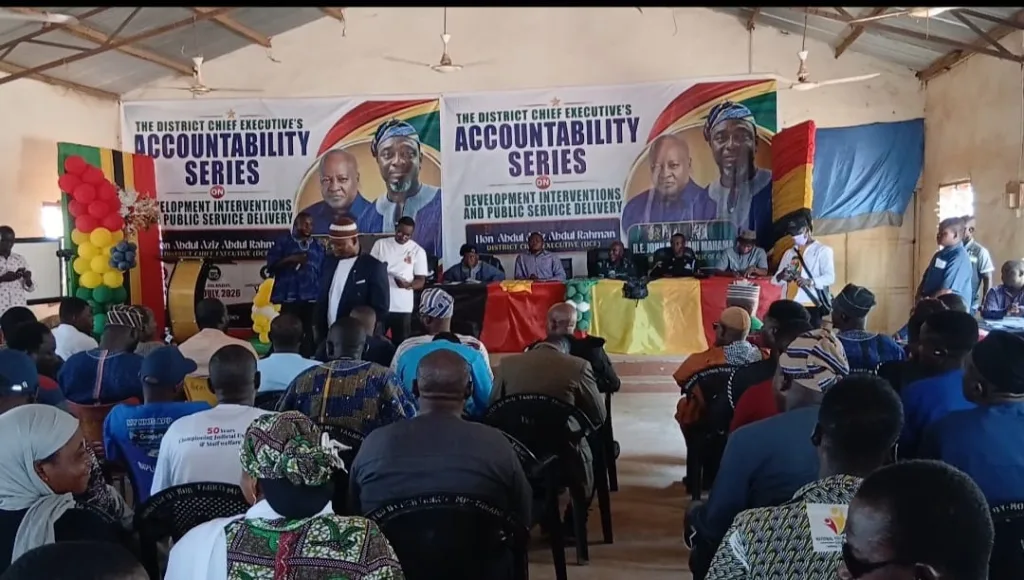
The Mamprugu Moagduri District Assembly in the North East Region has announced the implementation of 23 major development projects across key sectors between January 2025 and June 2026.
The single sharpest fact in one or two punchy sentences. Who did what, where, when, and why it matters.
The 23 projects were implemented by District Chief Executive Abdul Aziz Abdul Rahman, who presented the Assembly's maiden Public Accountability Series on Projects and Service Delivery. The projects spanned key sectors including education, health, water and sanitation, governance, security, and trade.
Education accounted for the largest share of projects with nine interventions, followed by four projects each in health and water and sanitation. The Assembly also implemented projects in governance, security, sanitation, and trade. These projects were funded by GH¢13.7 million from the District Assemblies Common Fund (DACF), representing 72.3 per cent of its approved 2025 budget of GH¢18.96 million.
The funds were invested in various projects including the construction and furnishing of CHPS compounds at Zukpeni and Zanloo, completion of the Yagaba CHPS Compound, renovation of health facilities, classroom blocks in several communities, dormitories for educational institutions, borehole drilling, rehabilitation of water systems, and the commencement of a modern 24-hour market at Yagaba.
The Assembly also highlighted significant gains in agriculture through interventions supported by the World Bank, GIZ, the African Development Bank and the Government of Ghana. Over 50,000 cashew seedlings were distributed to farmers, 3,456 smallholder farmers received agricultural inputs, 600 farmers were trained in climate-smart farming practices, 750 cockerels were distributed to 150 farmers, fertilizer subsidies reached 359 farmers, while 5,000 farmers were registered under the West Africa System Resilience Project.
On social protection, the Assembly said it received over GH¢520,000 under the Disability Common Fund, which was used to support persons with disabilities through the distribution of deep freezers, small ruminants, financial assistance for income-generating activities, educational support, NHIS registration, and other empowerment initiatives.
However, despite these achievements, the Assembly identified several challenges affecting development, including delays in the release of the DACF, inadequate funding, limited access to potable water, poor mobile network coverage, electricity deficits in newly developed communities, office accommodation shortages for decentralised departments, security concerns, and persistent open defecation in parts of the district.
To address these issues, the Assembly outlined its 2026 priorities, including extending electricity to underserved communities, drilling additional boreholes, constructing office facilities for the Ghana National Fire Service and National Ambulance Service, recruiting more than 70 street and market sweepers, constructing a police post at Yizeisi, intensifying the enforcement of sanitation by-laws, and expanding education and healthcare infrastructure.
The District Chief Executive reaffirmed the Assembly’s commitment to prudent financial management, stronger collaboration with government and development partners, and continued investment in projects that improve the living conditions of residents across the district.
The Assembly has taken a significant step in implementing various projects that have improved the lives of residents in the district. Despite the challenges faced, the Assembly is committed to addressing these issues and continuing to invest in projects that improve the living conditions of residents. With the outlined priorities for 2026, the Assembly is poised to make significant strides in development.