

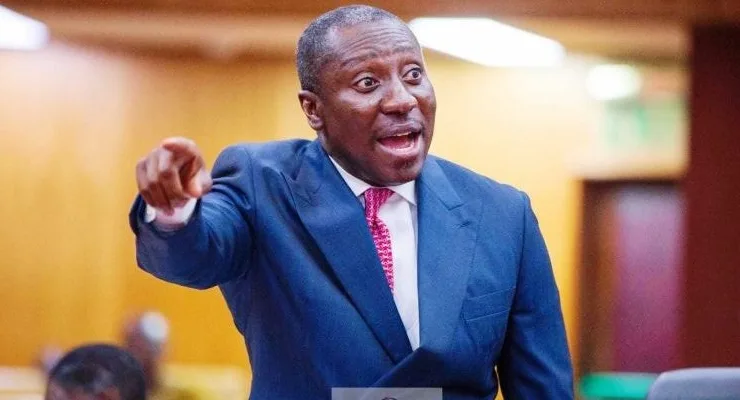
The single sharpest fact in one or two punchy sentences. Who did what, where, when, and why it matters. The Minority Caucus in Parliament has challenged the High Court's decision to sentence Ashanti Regional NPP Chairman Bernard Antwi-Boasiako to 20 years in prison. The court's ruling has sparked an outcry over allegations of selective justice and procedural irregularities.
The conviction of Chairman Wontumi and his firm, Akonta Mining Limited, was delivered by Justice Audrey Kocuvie-Tay at the High Court in Accra. The charges against them were under the Minerals and Mining Act, 2006 (Act 703), as amended.
Chairman Wontumi, a prominent figure in the NPP, was convicted on two counts each under the act. His lead counsel had formally notified the court of a pre-existing professional commitment outside the jurisdiction, but the trial proceeded without him.
The Minority Caucus has raised sharp constitutional objections to the ruling, describing it as a miscarriage of justice. They argued that the trial court infringed upon Article 19(2)(g) of the 1992 Constitution, which guarantees an accused person the right to be defended by a lawyer of their own choice.
The caucus referenced the landmark case of Tsatsu Tsikata, whose 2008 conviction was eventually overturned by the Court of Appeal on 30 November 2016. They alleged that the trial judge's decision to proceed while higher court questions remained unresolved constituted a miscarriage of justice.
The Minority further faulted Justice Kocuvie-Tay for refusing the defense team's application to refer constitutional interpretation questions regarding Section 99(2)(b) of Act 703 to the Supreme Court under Article 130. They relied on the precedent set in Republic v. The High Court, General Jurisdiction 6, Accra; Ex Parte Dr. Zanetor A. Rawlings (2016).
The statement added that lifting Akonta Mining Limited's corporate veil to hold Wontumi personally liable represented an exceptional legal remedy that required closer appellate scrutiny. It accused state prosecutors of applying a double standard based on political affiliation.
The Minority is planning to test the decision at the Court of Appeal and the Supreme Court. They also called for transparency and publication of the full enforcement record on illegal mining across the political spectrum.
Wontumi to Appeal Conviction Through Constitutional Channels
Chairman Wontumi, through his lawyer, has vowed to pursue certiorari and appellate remedies to challenge the conviction. The Minority Caucus has assured NPP members in the Ashanti Region and across the diaspora of their commitment to challenging the conviction through all constitutional channels.
We will challenge this conviction through every constitutional channel, starting from the Court of Appeal and ending at the Supreme Court.
The single sharpest fact in one or two punchy sentences. Who did what, where, when, and why it matters. Not a summary of everything — the one thing that makes someone stop scrolling.
The High Court ruling has sparked a heated debate over selective justice and the application of the law. The Minority Caucus has taken a strong stance in support of Chairman Wontumi, citing the 2008 case of Tsatsu Tsikata.
Akonta Mining Limited's Corporate Veil Lifted
The court's decision to lift Akonta Mining Limited's corporate veil to hold Wontumi personally liable has raised concerns. The Minority has accused state prosecutors of applying a double standard based on political affiliation.
Charges and Sentencing Details
Chairman Wontumi and Akonta Mining Limited were convicted on two counts each under the Minerals and Mining Act, 2006 (Act 703), as amended. The charges were related to illegal mining activities.
The Court's Ruling
The High Court's decision to sentence Chairman Wontumi to 20 years in prison has been met with widespread criticism. The court's ruling has been described as a miscarriage of justice by the Minority Caucus.