

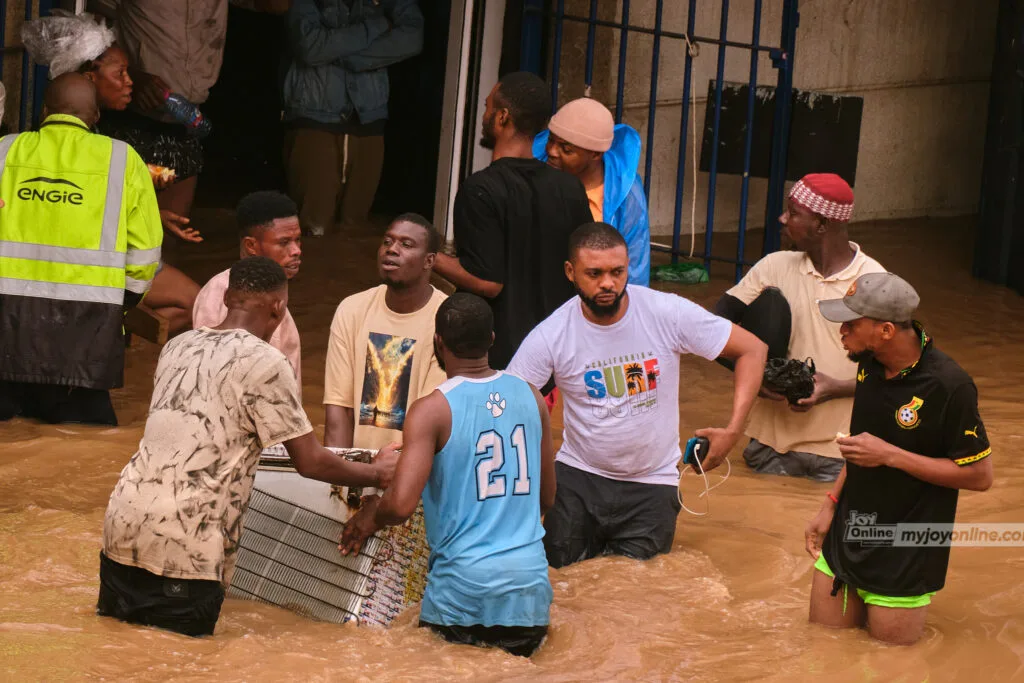
The single sharpest fact is that the Government of Ghana has established five specialised sub-committees to coordinate its national response to the recent flooding that affected parts of Greater Accra and other regions on June 28 and 29, 2026.
The committees form part of a broader post-flood mitigation task force activated by the President to streamline recovery efforts and strengthen national preparedness. Briefing journalists in Accra on Friday, July 3, Brigadier General Forster Okae-Yeboah, Director General of Joint Operations at the Ghana Armed Forces, outlined the structure guiding the government’s coordinated response.
He said the five sub-committees are the Post-Flood Mitigation Committee (formerly the Anti-Flood Task Force), the Early Warning Committee, the Sanitation and Health Committee, the Relief and Donations Committee, and the Emergency Communications Committee. According to him, the arrangement is designed to ensure an effective and coordinated response involving government institutions, security agencies, Metropolitan, Municipal and District Assemblies (MMDAs) and other stakeholders.
The Chief of Staff is leading the overall recovery effort on behalf of the President. “We shall not leave any stone unturned,” Brig. Gen. Okae-Yeboah assured, speaking on behalf of the sub-committees. He further explained that the Emergency Communications Committee will be responsible for providing regular and sustained public updates on the progress of recovery operations.
Beyond the immediate response, he noted that the committee structure also forms part of a wider national resilience strategy aimed at improving drainage systems, strengthening early warning mechanisms, enforcing planning regulations and enhancing emergency preparedness across the country.
The National Resilience Strategy is a comprehensive plan aimed at reducing the country's vulnerability to natural disasters. The strategy includes investments in infrastructure, emergency preparedness and response, and community resilience.
The Post-Flood Mitigation Committee will be responsible for coordinating the response efforts, while the Early Warning Committee will work on improving early warning systems to mitigate the impact of future floods. The Sanitation and Health Committee will focus on ensuring the health and well-being of affected communities, while the Relief and Donations Committee will manage donations and support to affected areas.
The Emergency Communications Committee will provide regular updates on the progress of recovery operations, ensuring that affected communities and the general public are informed. The Committee will also work to address misinformation and rumours that may circulate during the disaster response period.
The five sub-committees will work closely with government institutions, security agencies, MMDAs, and other stakeholders to ensure an effective and coordinated response to the flooding. The committees will also collaborate with international partners to access expertise and resources to support the recovery efforts.
The Government of Ghana has allocated Ghc 100 million for the post-flood relief efforts. The funds will be used to support affected communities, provide relief to affected households, and restore damaged infrastructure.
The National Disaster Management Organisation (NADMO) has already begun distributing relief items, including food, shelter, and non-food items to affected communities. The organisation has also established a hotline for affected individuals and families to report their needs and seek assistance.
The Government of Ghana is committed to providing support to affected communities and ensuring that the country learns from the experience to prevent similar disasters in the future.
Key Facts
- The Government of Ghana has allocated Ghc 100 million for the post-flood relief efforts.
- The funds will be used to support affected communities, provide relief to affected households, and restore damaged infrastructure.
- NADMO has established a hotline for affected individuals and families to report their needs and seek assistance.
- The National Resilience Strategy is a comprehensive plan aimed at reducing the country's vulnerability to natural disasters.
- The Post-Flood Mitigation Committee will be responsible for coordinating the response efforts.