

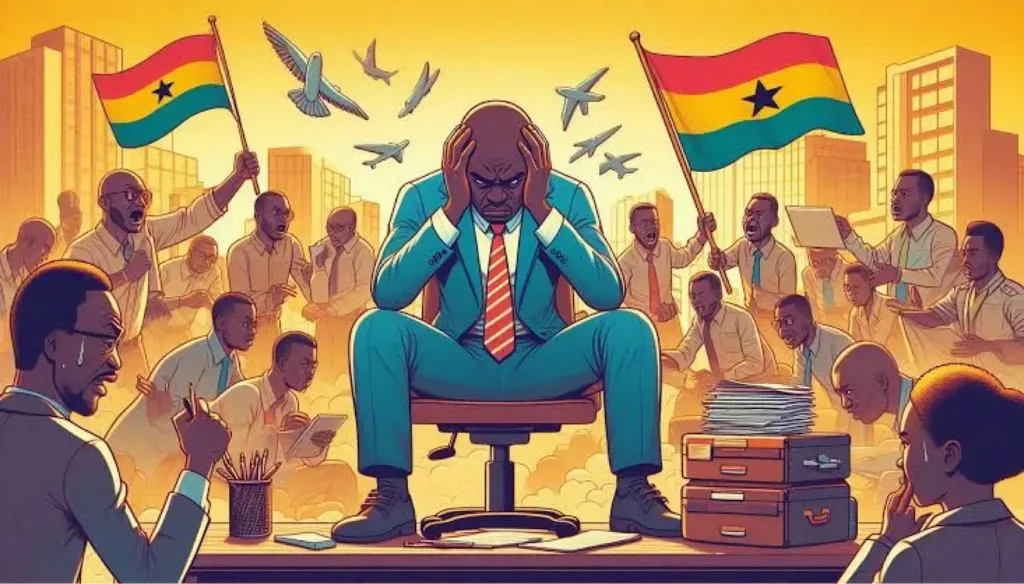
A viral video has sparked outrage after a Ghanaian MP berated a local government chief for being late to a hearing due to his wife's emergency surgery.
The single sharpest fact in one or two punchy sentences. Who did what, where, when, and why it matters. Not a summary of everything — the one thing that makes someone stop scrolling.
Ghana's workplace culture will be the end of us. Work, wellbeing and why Ghana's workplace culture needs an immediate rethink. Manuel Koranteng, a Ghanaian writer, recently shared his thoughts on why Ghana's workplace culture needs to change.
Ghana's workplace culture will be the end of us. Manuel Koranteng argues that in many workplaces in Ghana, personal emergencies are only justified when there's total immobility. But what does that mean? In a post on Father's Day, Koranteng highlighted the story of a local government chief who was berated by a Ghanaian MP for being late to a hearing due to his wife's emergency surgery.
The MP, who chaired the hearing, questioned and berated the MCE for being late, saying he 'cannot doctor or nurse' his wife. But Koranteng argued that the thinking that underlies this attitude is starkly uninformed. 'There's a lot of evidence of how much difference it makes to a person's recovery journey when they wake up to a familiar face after such procedures,' Koranteng said.
The presence of a loved one reduces post-operative anxiety and stress, which helps prevent complications like disorientation and agitation. The MP's attitude reflects the nation's callous attitude towards workers' personal emergencies. In Ghana, personal emergencies are only justified when you can't move.
Koranteng said that the thinking that underlies this attitude is starkly uninformed. 'We all do it!' the MP admitted in the course of the exchange. But that's the problem. Ghana's workplace culture needs to change to support mental wellbeing.
So if even an MCE can be treated like that, imagine what is expected of the average worker. The work takes everything from us and barely gives anything back. And before you talk about the fact that workers are paid a salary, remember, especially for our best talents, they can earn so much more for doing the same thing or even less, elsewhere.
That's why I'm not surprised that our highly skilled talents are leaving the country in droves. Ghana is the 4th most stressful country to work in, south of the Sahara.
For a nation so keen on protecting family values and keeping the family unit intact, this cannot be the way we proceed. This must change. It really must.
Ghana's workplace culture must be fit for purpose. And that purpose is to help us live a fulfilling life. Imagine that every parent chose their work every time their family needed them. How many of them would be 'intentional' and worth celebrating?
The single sharpest fact in one or two punchy sentences. Who did what, where, when, and why it matters. Not a summary of everything — the one thing that makes someone stop scrolling.
If Ghana's workplace culture is to change, it must be a national discussion that takes into account the impact of work on mental wellbeing. The nation's best talents will continue to leave if this attitude continues.
The Ghanaian government needs to work towards changing this attitude. Ghana's workplace culture must be fit for purpose. And that purpose is to help us live a fulfilling life.
Ghana's workplace culture is not just about punctuality or dedication to duty. It's about how our work supports us in the most difficult times.
The presence of a loved one reduces post-operative anxiety and stress, which helps prevent complications like disorientation and agitation. The MP's attitude reflects the nation's callous attitude towards workers' personal emergencies.
In Ghana, personal emergencies are only justified when you can't move. The thinking that underlies this attitude is starkly uninformed.
Koranteng said that this conversation is not just about one person or one incident. It's about how our work supports us in the most difficult times. And it's not just about the MP or the MCE. It's about the nation's attitude towards workers' personal emergencies.
If Ghana's workplace culture is to change, it must be a national discussion that takes into account the impact of work on mental wellbeing. The nation's best talents will continue to leave if this attitude continues.
So if even an MCE can be treated like that, imagine what is expected of the average worker. The work takes everything from us and barely gives anything back.
That's why I'm not surprised that our highly skilled talents are leaving the country in droves. Ghana is the 4th most stressful country to work in, south of the Sahara.
For a nation so keen on protecting family values and keeping the family unit intact, this cannot be the way we proceed. This must change. It really must.
Key Facts
- Ghana is the 4th most stressful country to work in, south of the Sahara.
- The presence of a loved one reduces post-operative anxiety and stress, which helps prevent complications like disorientation and agitation.
- In Ghana, personal emergencies are only justified when you can't move.
- The thinking that underlies this attitude is starkly uninformed.
- Ghana's workplace culture must be fit for purpose. And that purpose is to help us live a fulfilling life.
This article has sparked a national discussion about the impact of work on mental wellbeing. The nation's best talents will continue to leave if this attitude continues. Ghana's workplace culture must be fit for purpose. And that purpose is to help us live a fulfilling life.
Ghana's workplace culture is not just about punctuality or dedication to duty. It's about how our work supports us in the most difficult times.
The single sharpest fact in one or two punchy sentences. Who did what, where, when, and why it matters. Not a summary of everything — the one thing that makes someone stop scrolling.
The Ghanaian government needs to work towards changing this attitude. Ghana's workplace culture must be fit for purpose. And that purpose is to help us live a fulfilling life.