

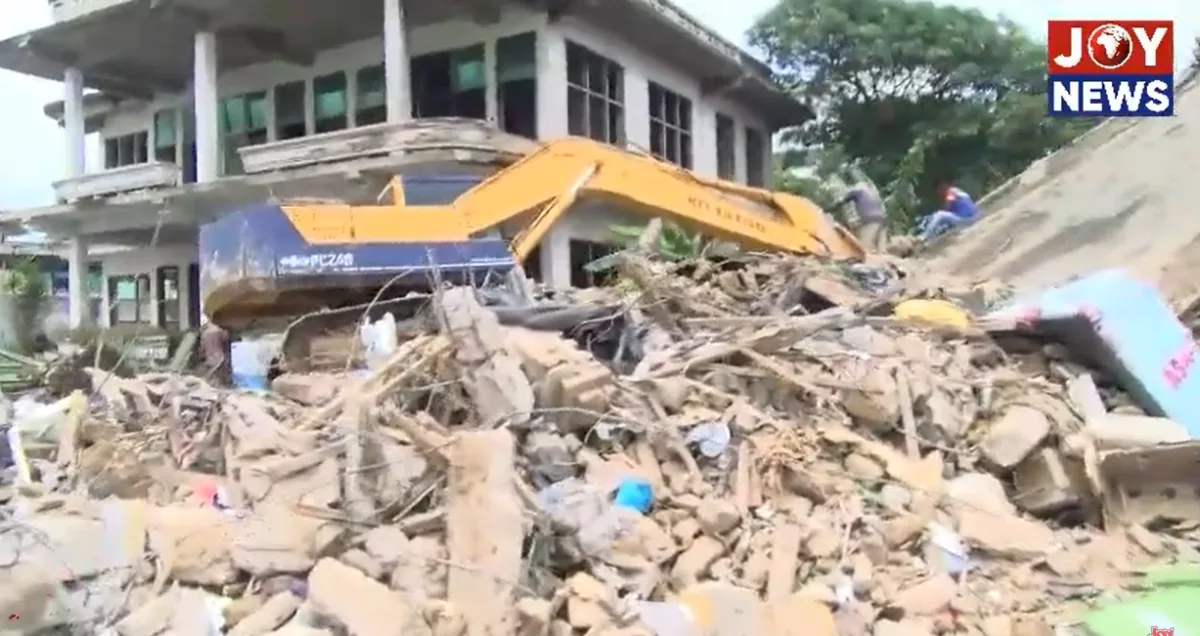
The National Disaster Management Organisation (NADMO) demolished a multi-storey building in Osu after a partial collapse raised fears of a complete structural failure. The building, which was over 50 years old, partially collapsed on Sunday, prompting an emergency response from the authorities, and sparked panic among residents and business owners in the area.
The demolition exercise, carried out on Monday, involved officials from the Ghana National Fire Service and the Korle Klottey Municipal Assembly, who declared the building unsafe and a significant risk to public safety because the structure was structurally unsound. Excavators were deployed to the site to bring down the weakened building after engineers and emergency officials assessed it. The decision to demolish the building was necessary to prevent further collapse and protect lives and property, particularly given the building's location in the busy commercial enclave of Osu.
It's also worth noting that the exercise forms part of ongoing efforts by emergency management agencies to eliminate dangerous structures that pose a threat to the public, especially in the wake of recent building collapses in parts of the Greater Accra Region. The Director-General of NADMO, Eric Nana Agyemang-Prempeh, said the demolition was a necessary step to safeguard public safety. According to him, the building's collapse was a major concern, and the authorities had to act fast to prevent further accidents.
The demolition exercise was a major operation, involving the deployment of heavy machinery and a team of experts from the Ghana Fire Service and the Korle Klottey Municipal Assembly. The exercise was completed in a matter of hours, with the building being brought down to the ground quickly.
The building's collapse has raised many concerns about the safety of ageing structures in the country. The Ghanaian government has announced plans to conduct a nationwide assessment of ageing structures to identify and rectify safety concerns. This assessment will help identify buildings that are at risk of collapse and need to be torn down or renovated to meet safety standards.
Key Facts
- The building was over 50 years old.
- The building collapsed on Sunday.
- The demolition exercise was carried out on Monday.
- The building's collapse was assessed as structurally unsound by engineers and emergency officials.
- The Ghanaian government has announced plans to conduct a nationwide assessment of ageing structures.
Authorities are expected to continue assessing other ageing structures to ensure they meet safety standards and prevent similar incidents from happening. The government has also called on property owners to ensure that their buildings are in good condition and comply with safety regulations, or face fines and penalties.
The collapse of the building has highlighted the need for better building codes and standards in the country. Experts have called for the implementation of stricter building codes and regulations to prevent similar incidents in the future. These new regulations should include regular inspections and maintenance of buildings, as well as stricter enforcement of safety regulations.
The building collapse is not an isolated incident. In recent years, there have been several building collapses in Ghana, resulting in loss of life and property.
In 2020, a building collapsed in Accra, killing several people and injuring many more. The incident highlighted the need for better building codes and regulations in the country. In response to the incident, the Ghanaian government established a taskforce to investigate building collapses and recommend measures to prevent such incidents.
The taskforce has identified several contributing factors to building collapses, including inadequate building codes, poor construction standards, and lack of enforcement of safety regulations. The Ghanaian government has announced plans to implement stricter building codes and regulations to prevent similar incidents in the future.
The collapse of the building has also raised concerns about the safety of buildings in the country. Experts have called for regular inspections and maintenance of buildings to prevent such incidents.
Next Steps
The Ghanaian government has announced plans to conduct a nationwide assessment of ageing structures to identify and rectify safety concerns. The assessment will involve the inspection of buildings across the country to determine their structural integrity, and identify any buildings that are at risk of collapse.
The government has also called on property owners to ensure that their buildings are in good condition and comply with safety regulations. Property owners who fail to comply with safety regulations may face fines and penalties. The government has also established a taskforce to investigate building collapses and recommend measures to prevent such incidents. This taskforce will conduct investigations into building collapses, identify contributing factors, and recommend measures to prevent similar incidents in the future.
Image Query
Building demolition in Osu, Ghana.