

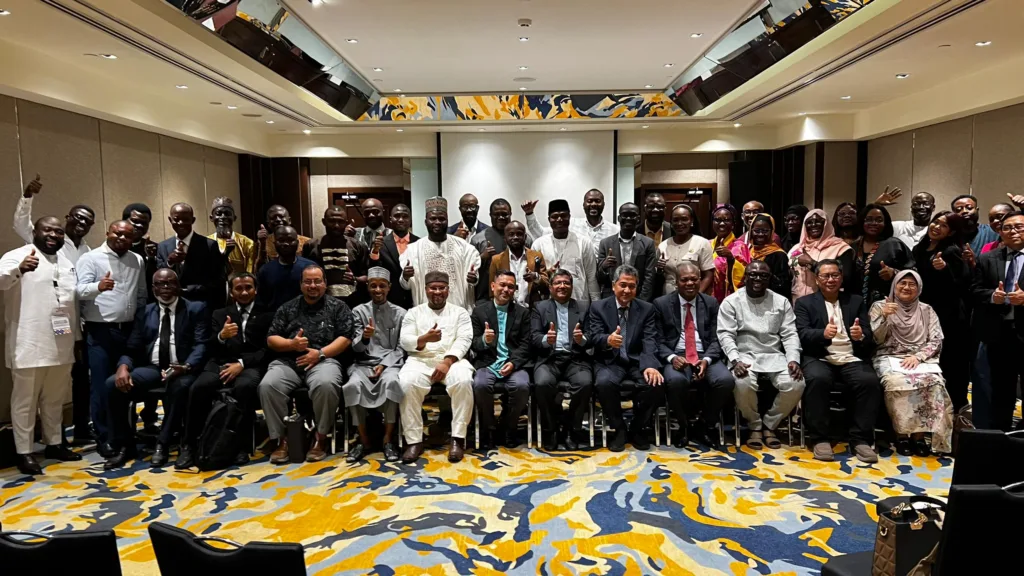
The single sharpest fact is that Ghana's financial leaders have returned from a five-day tour in Malaysia with the knowledge and resolve to reshape the country's financial landscape. The International Executive Training & Study Tour on Non-Interest Banking, Capital Markets, and Takaful (Insurance) brought together financial professionals from Ghana, Nigeria, and beyond from 22nd to 26th June 2026. The programme, organised by the Islamic Finance Research Institute of Ghana (IFRIG) in collaboration with the Centre for Islamic Economics (CIE) at the International Islamic University Malaysia (IIUM), exposed participants to Malaysia's globally recognised dual-banking system, Sukuk markets, and regulatory framework. The system is widely regarded as the most advanced of its kind in the world. Ghana's financial leaders are now armed with the knowledge to build a new financial era for West Africa.
Ghana's Deputy High Commissioner to Malaysia, Professor Naail Mohammed Kamil, expressed optimism that the tour had exposed the high-ranking delegation to a deeper understanding of Non-Interest Banking. 'I have always believed that this is the best alternative to solving Ghana's development problems. It discourages speculation, encourages productive economic activity, and aligns finance with real assets,' Professor Naail stated. The non-interest banking system is not limited to Muslims, as many believe, but is a financial model that can benefit the entire humanity.
Dr. Ali Shaibu, Executive Director of IFRIG and Deputy CEO of Trustmark Capital Ltd, issued a powerful charge to participants: 'Be apostles of Non-Interest Banking.' He emphasized that capacity building remains essential to implementation, adding that the model can be used for the development of Ghana's financial system while helping lift the population above the poverty line. The programme's lead trainer, Alhaji Attahiru Maccido, confirmed that the programme's objectives had been fully achieved through the exchange of knowledge shared. He was quick to clear a common misconception: 'Non-Interest Banking is not only for Muslims—it is meant for the entire humanity. It is about fairness, risk-sharing, and transparency—values that any entrepreneur, regardless of faith, can benefit from.'
And what makes Ghana's financial leaders so confident? The programme exposed them to the best practices of the Malaysian dual-banking system, which has been in operation for 40 years. Professor John Gatsi, who led the Bank of Ghana delegation, allayed fears that Non-Interest Banking could destabilise the country's traditional banking system. 'I want to allay the fear that Non-Interest Banking will collapse the current traditional banking system. That is not the case. We are here to learn how to build a complementary system, a robust dual-banking framework that offers choice, encourages competition, and strengthens our overall financial stability,' Professor Gatsi assured.
But what are the numbers behind this bold plan? The International Islamic University Malaysia (IIUM) has been a pioneer in Islamic finance for over four decades. The Centre for Islamic Economics (CIE) at the IIUM has conducted extensive research on the subject. The Ghanaian delegation was exposed to their research and best practices. The country is now poised to reap the benefits of non-interest banking.
And what's next? The programme's objectives have been fully achieved, and Ghana's financial leaders are now equipped with the knowledge and resolve to implement the non-interest banking system in Ghana.
And what does this mean for the future of Ghana's finance sector? Professor James Klutse Avedzi, Director General of the Securities and Exchange Commission (SEC), noted that the knowledge acquired during the visit will enrich regulatory roles. 'Malaysia has the most advanced Islamic finance framework in the world. Learning from them is the best decision we could have made,' he said. Ghana is now set to integrate non-interest banking into its financial landscape, and participants return home equipped with practical insights and best practices drawn from Malaysia's journey in Islamic finance.
'I urge every one of you to be apostles of Non-Interest Banking. Let me be emphatic—this is not a religious agenda. This is a financial model that can transform our country's financial system. It is ethical, transparent, and for every Ghanaian, regardless of faith.'
Ghana's financial leaders have returned from Malaysia with a bold plan to revolutionize the country's finance sector by adopting a non-interest banking system. The system is a financial model that can transform the country's financial system, making it more ethical, transparent, and fair for all Ghanaians.
And what's next? Ghana is now set to implement the non-interest banking system in its financial landscape. The programme has achieved its objectives, equipping Ghana's financial leaders with knowledge and resolve to build a new financial era for West Africa. Dr. Ali Shaibu, Executive Director of IFRIG and Deputy CEO of Trustmark Capital Ltd, has issued a powerful charge to participants: 'Be apostles of Non-Interest Banking.' Ghana's financial leaders are now poised to reap the benefits of non-interest banking.
Key Facts
- Ghana's financial leaders have returned from a five-day tour in Malaysia with the knowledge and resolve to reshape the country's financial landscape.
- The programme, organised by the Islamic Finance Research Institute of Ghana (IFRIG) in collaboration with the Centre for Islamic Economics (CIE) at the International Islamic University Malaysia (IIUM), exposed participants to Malaysia's globally recognised dual-banking system, Sukuk markets, and regulatory framework.
- Professor John Gatsi, who led the Bank of Ghana delegation, allayed fears that Non-Interest Banking could destabilise the country's traditional banking system.
- The programme's objectives have been fully achieved, equipping Ghana's financial leaders with knowledge and resolve to implement the non-interest banking system in Ghana.
- Ghana is now set to integrate non-interest banking into its financial landscape, and participants return home equipped with practical insights and best practices drawn from Malaysia's journey in Islamic finance.
In the wake of increasing poverty in Ghana, the non-interest banking system could be a game-changer. Ghana's financial leaders have finally returned with the knowledge and resolve to implement this system, transforming the economy and making it more inclusive for all Ghanaians.