

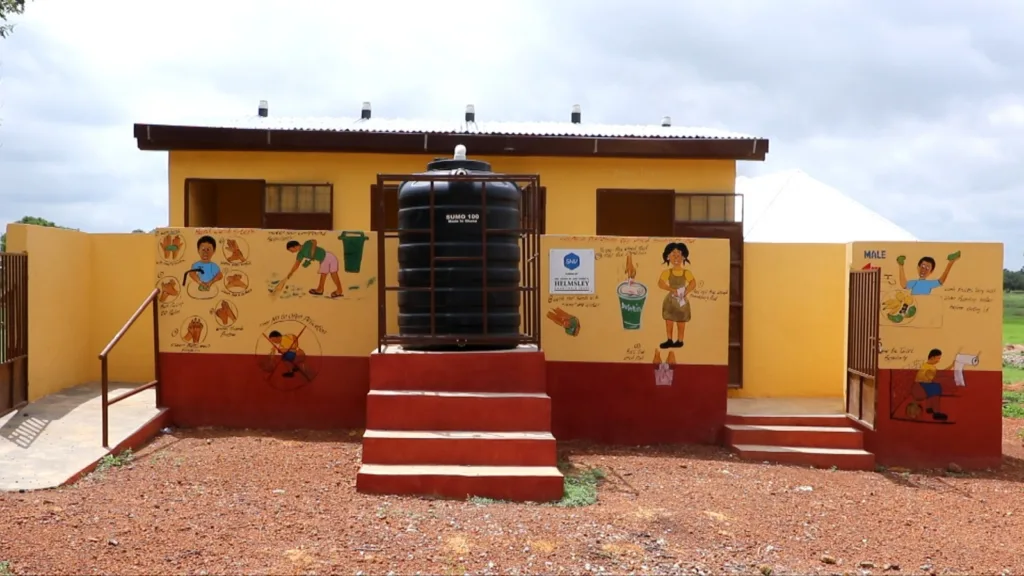
For years, pupils at Nandom English and Arabic Basic School had to watch out for crocodiles and snakes when they went to ease themselves. The school had one dilapidated community toilet, so most children resorted to the bush.
Headmistress Ibrahim Aisha remembers the day a crocodile attacked an animal right outside the school. “The environment isn't always conducive. There was even a day a crocodile had to attack an animal there when we were sitting here,” she said. “When it rains like this, the place gets flooded, and because of that, there are reptiles around.”
Form Two student Abdul Samed Mohammed said one of his friends once encountered a snake in the bush. “Luckily, we killed it,” he said.
Female students had it worse. Without private changing rooms, many girls skipped classes when they had their period. Form Two student Abdullah Khadijah explained, “Sometimes if we go home, we don’t come back again because the way to the house is sometimes far.”
That reality is changing through the Healthy Future for All Phase II (HF4A II) project, implemented by SNV Ghana with funding from the Leona M. and Harry B. Helmsley Charitable Trust. The project is building gender-inclusive sanitation facilities in 26 schools across the municipality.
Theresa Swanzy Baffoe, Project Manager for HF4A II, said the design puts girls first. “For each of the facilities on the girls’ side, we have a changing room to ensure that we have a safe place for our daughters to also change and feel safe in their schools,” she said.
The project also reaches health facilities. At Piiri Health Centre, which serves about 6,708 residents, expectant mothers used to carry buckets of water before they could receive maternal care. Staff Nurse Ziema Paul Sunkari said that burden was unfair. “They’re pregnant, and you are adding them another burden,” he said.
The lack of water even endangered children with high fevers. Health workers sometimes couldn't find enough water for tepid sponging — a simple procedure that brings down body temperature and prevents convulsions. SNV Ghana installed a solar-powered mechanised water system, giving the facility reliable water for sterilising instruments and treating patients.
Community member Thadeus Siemolu recalled that the whole community once depended on only two boreholes. Now, the water network has expanded, bringing clean water to households and the health centre. Expectant mothers like Justina Kaba can visit the clinic without carrying buckets.
Beyond water and toilets, SNV Ghana is helping women earn money. The Kelegang Enye Women Group 1 has started a thriving liquid soap business after receiving loans through a revolving fund. Secretary Mercy Wange said the programme has transformed the lives of its 35 members.
The group first got a GH¢80,000 loan, then another GH¢53,000. They used the money to expand soap production. “Initially, we were saving just two cedis, but now we have increased our savings to 25 cedis with the loan,” Madam Wange said. Many women now contribute to household expenses and help pay their children’s school fees.
Another beneficiary, Janet Dizaogl, owner of Mama J Enterprise, used a GH¢10,000 loan to diversify from pito brewing into liquid soap, soya kebabs and food processing. She has trained more than six others in her community.
The HF4A II project shows that investing in water, sanitation and women’s businesses can change a whole community. No more crocodiles in the schoolyard. No more pregnant women hauling water. Just cleaner schools, healthier families and women who can pay their children’s school fees.