

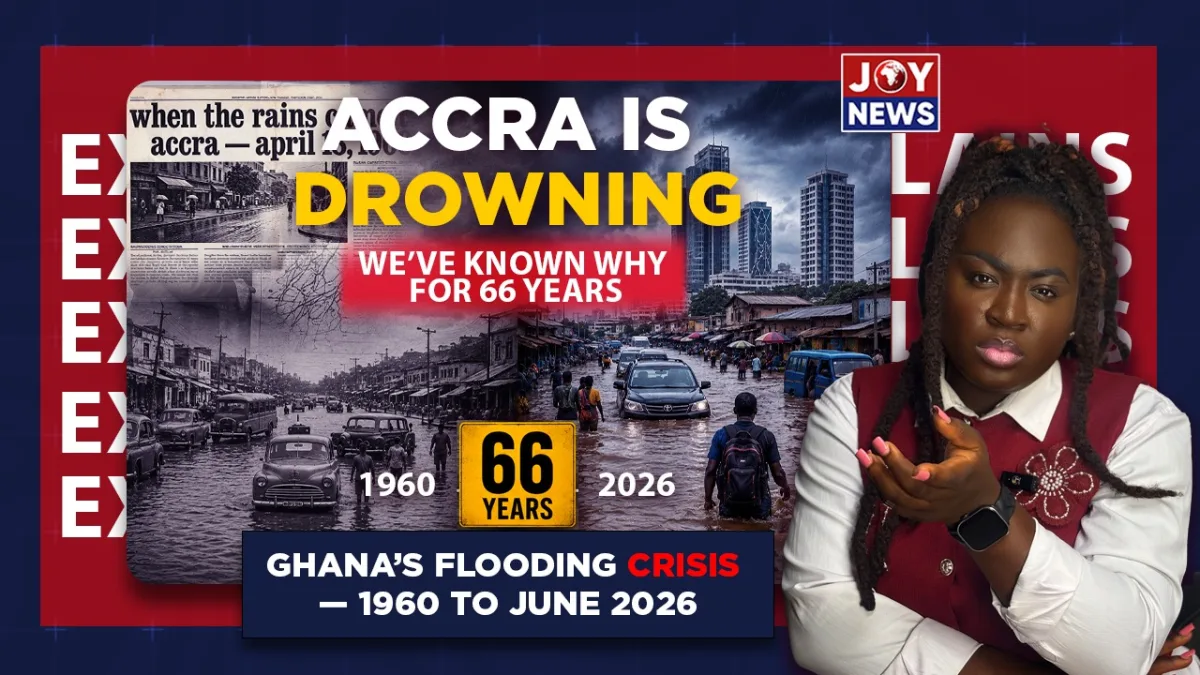
A body was found in the floods at Tetegu on June 14, 2026. It's, by now, a familiar kind of headline.
Weija. Parts of Kasoa. Dansoman. Ofankor Barrier. Lakeside. Major roads across the capital turned into rivers last week, trapping commuters and forcing families from their homes. This is the latest entry in a disaster log that stretches back further than most Ghanaians realise.
The Daily Graphic’s front page on April 18, 1960, carried a headline that could be reprinted today with only the date changed: “WHEN THE RAINS CAME TO ACCRA.” Sixty-six years later, the city is flooding in the same places, for largely the same reasons.
Accra sits on a coastal plain drained by a handful of rivers and lagoons. The Odaw River is the central one, emptying into the sea through the Korle Lagoon. Nine major drainage basins carry the city’s runoff, but the Odaw basin is where the worst disasters concentrate: low-lying, densely populated, ringed by informal settlements.
The causes aren't mysterious. Every credible study points to the same five factors: the city’s low-lying geography; homes and businesses built directly on floodplains and drainage channels; drains choked with plastic waste and sachet-water bags; drainage infrastructure designed for a much smaller city; and zoning and wetland-protection laws that exist on paper but are routinely ignored.
President John Mahama, speaking on May 31, 2026, described the flooding as “not an engineering problem” but “a problem of indiscipline,” pointing to plastic waste and construction on waterways. The framing is only half the story — the engineering deficit is real and decades deep — but it captures a central, uncomfortable truth: Accra floods not because of how much it rains, but because of what has been done to the land the water needs to pass through.
That truth was visible to this publication’s Explains desk long before this month’s floods. While covering the demolition of illegal structures at the Sakumo Ramsar site — one of Ghana’s internationally protected wetlands — JoyNews’ Jacqueline Ansomah Yeboah witnessed the scale of encroachment firsthand.
“I saw it with my own eyes, how flooded that area was, how badly encroached,” she said. “But what struck me most was that the landowners were against the demolitions. People had built on a protected wetland, a site that exists specifically to absorb floodwater — and they fought to keep those structures standing. That moment told me everything about why Accra keeps flooding.”
National flood data compiled from 1935 to 2023 records more than 3,000 flood-related deaths in Ghana and over 700,000 people displaced across that span. For most of the 20th century, the disasters were chronic rather than spectacular: annual inundations claiming lives in small numbers, displacing thousands, destroying property without producing a single galvanising catastrophe.
That changed on June 3, 2015. After hours of torrential rain submerged the Kwame Nkrumah Circle area, floodwaters carrying a film of fuel reached a GOIL filling station where hundreds had taken shelter. The station exploded. The combined flood-and-fire disaster killed an estimated 150 to 250-plus people, with around 25 deaths attributed directly to the flooding and the remainder to the inferno. The day is now commemorated annually as National Flood Disaster Day.
This year marks eleven years since that disaster.
The official damage assessment that followed valued the destroyed property — five houses and the filling station — at roughly GH¢1.66 million, then about US$428,000. That figure captured the buildings, not the lives, the lost trade, or the systemic cost. Eleven years on, a 2015 lawsuit brought by survivors and bereaved families remains undetermined.
The years since have brought a steady drumbeat of smaller, recurring tragedies. 2023 was, by recent count, the worst single year for frequency, with around 20 separate flooding incidents. On May 18, 2025, a three-hour downpour that dropped 132.2mm of rain killed four people including a child swept through gutters in Nima and displaced more than 3,000.
Days into June 2026, heavy rain again submerged Kaneshie, Odawna, Adabraka, the Circle enclave, Aboabo and Lapaz, with emergency responders working through the night to evacuate residents. The government activated emergency response measures on June 6, again citing “human activities” as the major cause. The UNDP described the disaster days later under a headline that needed no embellishment: “Accra Under Water Again.”
The economics of Accra’s flooding are, in the words of one 2026 commentary, an exercise in paying repeatedly for a disaster that could have been prevented once. A frequently cited World Bank estimate puts flood-related losses to the Ghanaian economy at roughly US$100 million annually. That doesn't include the cost of lives, the trauma, or the lost productivity of thousands of people whose homes and businesses are wrecked year after year.
- Over 3,000 flood-related deaths in Ghana from 1935 to 2023
- More than 700,000 people displaced in the same period
- June 3, 2015 disaster: 150–250+ killed at GOIL filling station
- 2023: worst year for frequency with about 20 flooding incidents
- May 18, 2025: 132.2mm rain killed 4, displaced 3,000+
- World Bank: flood losses roughly US$100 million annually
- GH¢1.66 million (US$428,000) official damage assessment for 2015 disaster
For the poor, it's the worst. They live in the low-lying areas, in the informal settlements that clog the drainage channels. They're the ones who lose their homes, their belongings, sometimes their lives. And they're the ones who wait — for the water to recede, for the government to act, for the next flood to come.
Sixty-six years after that 1960 headline, Accra is still waiting.