

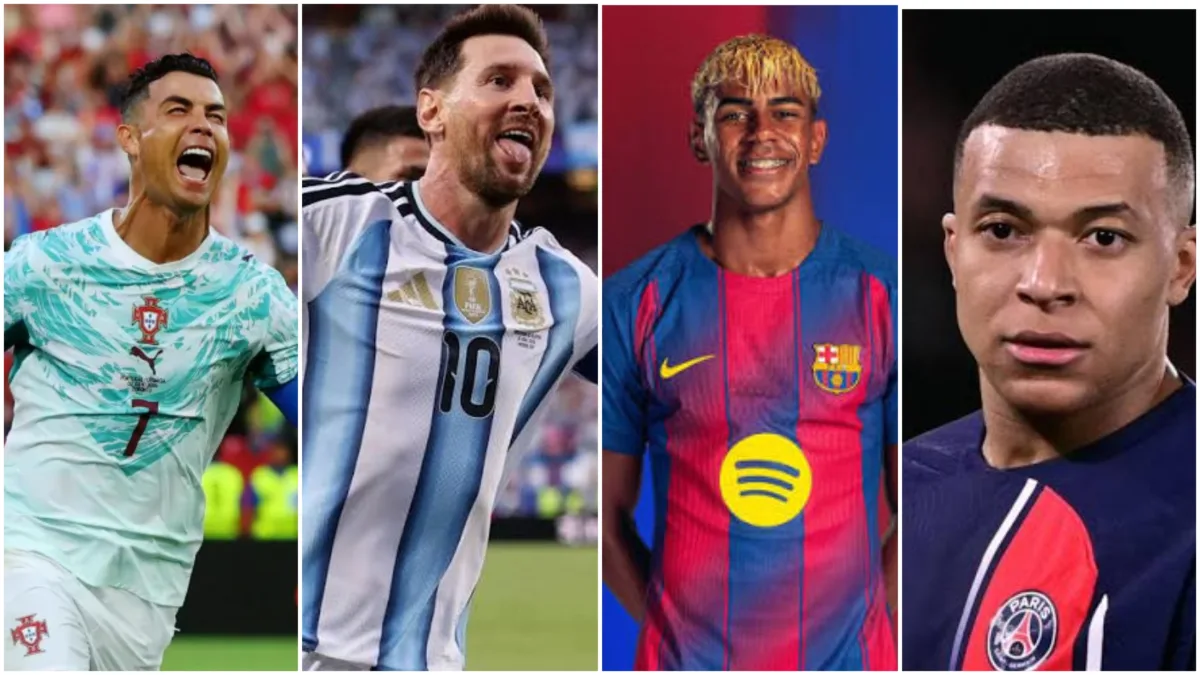
The single sharpest fact in one or two punchy sentences. You could only read this paragraph and still understand what happened. Cristiano Ronaldo and Lionel Messi, the world's greatest footballers for nearly two decades, are being eclipsed by a talented new generation.
Inside a packed stadium, tens of thousands of supporters rise almost instinctively as Cristiano Ronaldo drifts into the penalty area. They have seen this movement countless times over two extraordinary decades. The anticipation is almost muscle memory. Another reminder that football’s oldest superstar still refuses to surrender to time.
Yet, as Portugal celebrates, another truth quietly unfolds around him. That paradox has become one of the defining stories of the 2026 FIFA World Cup. For nearly two decades, football’s biggest debates—from Ballon d’Or races to World Cup legacies—have eventually circled back to Cristiano Ronaldo and Lionel Messi. Their rivalry transcended clubs, countries and generations, pushing each other to unprecedented heights while redefining what sustained greatness looks like.
But for the first time in almost 20 years, they are no longer carrying football alone. A new generation has arrived—not waiting politely in the shadows but demanding the spotlight. For the first time since Ronaldo and Messi began their extraordinary dominance, the biggest story at a World Cup is no longer simply what the legends can still achieve. It is also about who will inherit and transform the game they defined.
Ronaldo and Messi did not simply excel. They reshaped football itself. Ronaldo transformed elite professionalism into an obsession through relentless training, scientific recovery and an unyielding determination to outlast everyone. Messi slowed the game to his own rhythm, turning football into an art form built on vision, precision and impossible angles.
Together, they dominated the global game for two decades in a way no previous generation had managed. They also benefited from—and accelerated—the evolution of modern football through sports science, global scouting networks, social media and the immense financial power of Europe’s elite clubs.
Now, that era is gradually drawing to a close. Not with a dramatic collapse, but with a graceful and inevitable transition unfolding across stadiums in North America. Cristiano Ronaldo continues to challenge time with characteristic defiance. His brace against Uzbekistan made him the first player to score in six different World Cups. Yet against younger and more physically demanding opponents, signs of fatigue have inevitably surfaced.
Portugal increasingly relies on younger legs to press aggressively and recover possession, allowing Ronaldo to conserve energy for decisive moments.
Lionel Messi has chosen adaptation over resistance. At 39, his explosive acceleration has diminished, but his football intelligence remains unrivalled. A hat-trick against Algeria and further goals, including a trademark free-kick against Jordan, have taken his World Cup tally to 19—the highest in the tournament’s history. Even when introduced from the bench, he continues to influence matches through vision, composure and impeccable decision-making.
Neymar’s story has been more complicated. Limited by recurring fitness problems to substitute appearances, the Brazilian has become an emotional bridge between generations rather than the creative force around whom Brazil once revolved.
Each legend has responded differently to the same reality: the body eventually slows. The competitive spirit rarely does. Modern football has evolved around them. It is faster, more vertical, more athletic and increasingly collective. High pressing, rapid transitions and positional flexibility now define success at the highest level.
The tactical evolution mirrors the physical one. Teams are moving away from building entire systems around one transcendent superstar towards coordinated pressing, fluid positional rotations and collective intensity. Even football’s greatest players now flourish best within systems designed to maximise every individual rather than revolve around one.
That is precisely why the new generation fits this era so naturally. Kylian Mbappé is no longer “the next Messi.” At 27, he combines breathtaking athleticism with growing tactical maturity. He drops deeper to link play, leads the press and stretches defences in ways perfectly suited to France’s transition-based football. Multiple braces, including one against Sweden, have kept him firmly in contention for the Golden Boot.
Vinícius Júnior has become Brazil’s principal outlet in transition. His high positioning, relentless pressing and fearless running have reinvigorated the Seleção. Unlike Neymar’s flair-heavy style, Vinícius attacks space with urgency, perfectly reflecting football’s m.
A more recent generation is stepping up to lead the football revolution in Nigeria and beyond. Led by players such as Victor Osimhen and Samuel Chukwueze, African teams are competing on the world stage with increasing confidence and skill. This new generation is poised to make a lasting impact on the beautiful game.