

A Coach in the Making
Mikel Arteta is known for his tactical genius, but even his closest friends didn't see it coming. Born in Gipuzkoa, Spain, Arteta was always a bit different. His friends at Antiguoko, a youth club in San Sebastián, remember him as a tiny but two-footed No 10 who was dedicated and smart. They recall that he was a coach already, pausing games to rewind and analyse tactics and strategies, and explaining to his friends what he saw.
'He was a coach already,' says Santi Cazorla, Arteta's friend and former Arsenal teammate. 'All game, every game: pausing, rewinding. The match is finished and we're only in the 35th minute. 'Do you see it?' 'Yes, yes, you're right, now come on, press play.' But I didn't see it.'
Arteta's obsession with football started at a young age, and his friends would often tease him for rewinding games to analyse the tactics and strategies of the players. But Arteta would explain that he was trying to understand the game better, that he didn't think a player was in the right position, and that if they moved back, it would create space. His friends would often ask him what he was stopping the game for, but Arteta's reply would show that he was already developing his coaching skills.
His friends at Antiguoko remember him as a team player who always looked out for others. 'He was super-responsible, he had something,' says Jofre Mateu, Arteta's teammate at La Masia. 'He wasn't there to piss about, he was there to do the right thing.' They recall that Arteta was a player who always put the team first, and this characteristic would serve him well in his future coaching career.
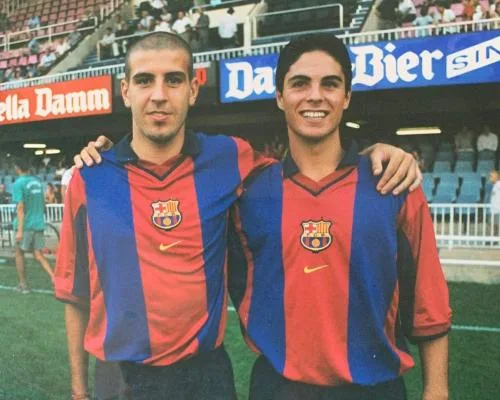
Arteta's move to Barcelona at 14 marked a turning point in his career. At La Masia, he was surrounded by talented young players, but he stood out for his exceptional intelligence and understanding of the game. 'We would go to the cinema,' recalls Luis Carrión, Arteta's Barcelona B teammate. 'We'd watch movies, and I'd sit next to Mikel, and he'd ask me questions about the tactics and strategies of the characters.' This curiosity and passion for analysis would become a hallmark of Arteta's coaching style.
But despite his talent, Arteta didn't make it as a player in Catalonia. He was released by Barcelona at 19 and went on to play for Paris Saint-Germain, Glasgow Rangers, and Everton, eventually becoming a player-manager at Manchester City.
### A Coach in His Own Right
Arteta's coaching career began in earnest when he joined Pep Guardiola's management team at Manchester City. He learned the ins and outs of Guardiola's tactics and strategies, which would eventually become his own. Arteta would often work closely with Guardiola, studying his methods and learning from his experience.
'I went to see Mikel do a session, and I thought, 'Bloody hell, look at Mikel,' ' said Luis Fernández, PSG coach. 'He was a kid with personality, polite, very professional for his age.'
In 2019, Arteta became the coach of Arsenal, leading the team to the Europa League final and eventually the Champions League final. He is known for his tactical genius, but also for his ability to connect with his players and inspire them to perform at their best. Arteta's success as a coach is built on his ability to motivate and inspire his players.
### A True Football Intellectual
Arteta's love of football analysis has been evident throughout his career. He is a true football intellectual, always looking for ways to improve his game and the games of those around him. Arteta's friends and former teammates remember that he would explain complex concepts in simple terms, through repetition and practice. 'He would explain concepts – third man, triangles, final line – but it wasn't classes, more repetition: passing drills every day,' says Roberto Trashorras, Arteta's teammate at La Masia.
Arteta's obsession with football analysis has been a key factor in his success as a coach. He is always looking for ways to improve his game and the games of those around him, and this drive has earned him a reputation as one of the most intelligent and innovative coaches in the game. His ability to connect with his players and inspire them to perform at their best is built on his deep understanding of the game and his passion for analysis.
Key Facts
- Arteta was born in Gipuzkoa, Spain, and began playing football at the age of 5.
- He joined Barcelona's youth academy at 14 and played for their B team.
- Arteta was released by Barcelona at 19 and went on to play for several clubs, including Paris Saint-Germain, Glasgow Rangers, and Everton.
- He joined Pep Guardiola's management team at Manchester City and eventually became the coach of Arsenal.
- Arteta led Arsenal to the Europa League final and eventually the Champions League final.