

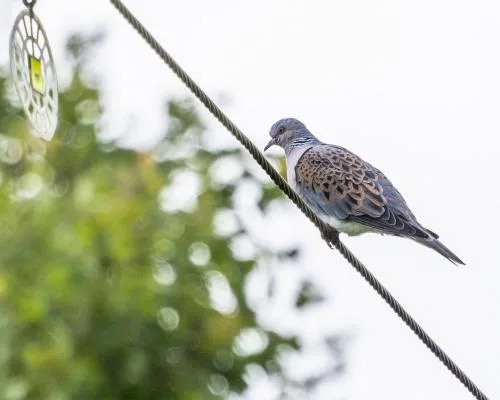
The single most striking fact about the turtle dove is that its population in the UK has plummeted by about 99% since the 1960s. This statistic is even more alarming when you consider that a lone bird was recently spotted on a telegraph wire in the Maxey Cut, a flood-relief channel completed 70 years ago.
The Maxey Cut runs through land that has been reshaped by quarrying for gravel, and its restoration has created a landscape of flowery grassland, willow, reedbeds, and open water – all a haven for wildlife. The turtle dove's critically endangered status in the UK makes every sighting significant.
Sarah Lambert, a keen observer of nature, recently visited the Maxey Cut and spotted the lone turtle dove. She noted that the bird looked a little travel-worn, which is understandable given it's a 3,000-mile flight from its wintering grounds in west Africa. Lambert also mentioned that she had watched 30 turtle doves in Crete a fortnight ago, strung along another set of wires, resting before the last stretch of their treacherous journey across mainland Europe.
The supplementary feeding scheme, supported by Operation Turtle Dove and administered locally by the Langdyke Countryside Trust, is helping to improve breeding success. Sensitive management of the river by the Environment Agency, creating pools, riffles, and meanders, and removing obstacles to fish movement, has also helped other threatened species, including sea trout and common eel.
Earlier this month, a new interpretive trail opened in the Maxey Cut, allowing anyone walking the area to encounter the distinctive wildlife of this fen-edge place – and, with luck, hear again that soft, improbable purr of the turtle dove. The turtle dove's low, tender purring, almost lost in the greater chorus, is a sound that Lambert finds particularly captivating.
The turtle dove's story isn't just about a single species; it's also about the broader ecosystem and the interconnectedness of wildlife. The Maxey Cut, with its flowery grassland and open water, is a haven for various species, including the willow warbler, the sedge warbler, and the Cetti's warbler.
The Maxey Cut is special because of its history. It was completed 70 years ago and was designed to protect fen-edge towns such as West Deeping and Deeping St James from flooding. Over time, the area has been reshaped by quarrying for gravel, and its restoration has created a unique landscape that supports a wide range of wildlife.
The story of the turtle dove and the Maxey Cut serves as a reminder of the importance of conservation and sensitive management of the environment. It's a story that highlights the interconnectedness of species and ecosystems, and the need for continued efforts to protect and preserve our natural world. The turtle dove can't be saved without these efforts, and it won't survive if we don't take action.
Key Facts
- The turtle dove population in the UK has fallen by about 99% since the 1960s.
- A lone turtle dove was spotted on a telegraph wire in the Maxey Cut after a 3,000-mile flight from its wintering grounds in west Africa.
- The Maxey Cut is a flood-relief channel completed 70 years ago.
- The area has been reshaped by quarrying for gravel, and its restoration has created a landscape of flowery grassland, willow, reedbeds, and open water.
- A supplementary feeding scheme, supported by Operation Turtle Dove and administered locally by the Langdyke Countryside Trust, is helping to improve breeding success.
The story of the turtle dove and the Maxey Cut shows that even in the face of significant decline, there's still hope for conservation and the preservation of our natural world. It's a story that reminds us of the importance of continued efforts to protect and preserve the environment, and the need for sensitive management of our ecosystems. We can't afford to give up, and we won't succeed if we don't work together to save species like the turtle dove.