

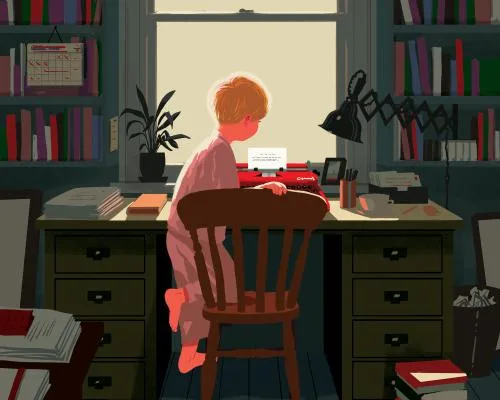
The literary world is witnessing a surge in the number of children of famous novelists who are becoming writers themselves. This year alone has seen the publication of debut novels by Naomi Ishiguro, daughter of Kazuo Ishiguro, and Jess Gibson, daughter of Margaret Atwood. Patrick Charnley, son of the late poet and novelist Helen Dunmore, has also published his first novel to widespread acclaim. This trend has sparked debates about the role of family connections in the literary world and whether having a novelist parent is a guarantee of success.
The phenomenon of literary nepo babies is not new, however. Throughout history, there have been instances of writers' children following in their footsteps. Alexandre Dumas père and fils, Fanny and Anthony Trollope, and Arthur and Evelyn Waugh are just a few examples. But the current crop of literary nepo babies is notable for its sheer number and diversity. From fantasy to literary fiction, these young writers are making their mark on the literary scene.
So, what drives these children of famous novelists to become writers themselves? Is it a desire to follow in their parents' footsteps, or is it a genuine passion for storytelling? According to Nick Harkaway, son of John le Carré, it's a bit of both. Harkaway has published eight novels and has recently begun to extend his father's output, writing new novels featuring established le Carré characters. He says that growing up in a writer's household didn't seem unusual at the time, but it did instill in him a love of storytelling and a sense of possibility.
Deborah Moggach, whose novels include Tulip Fever and These Foolish Things, also comes from a family of writers. Her parents were both authors, and her daughter, Lottie, has also become a novelist. Moggach says that having a writing parent can be both a blessing and a curse. On the one hand, it can provide a sense of security and a network of contacts in the literary world. On the other hand, it can create unrealistic expectations and pressures to live up to one's parent's reputation.
Key Facts
- Naomi Ishiguro, daughter of Kazuo Ishiguro, has published her debut novel this year.
- Jess Gibson, daughter of Margaret Atwood, has published her fiction debut this spring.
- Patrick Charnley, son of Helen Dunmore, has published his first novel to widespread acclaim.
- Nick Harkaway, son of John le Carré, has published eight novels and is extending his father's output.
- Deborah Moggach's daughter, Lottie, has also become a novelist.
- The literary world is witnessing a surge in the number of children of famous novelists who are becoming writers themselves.
- Alexandre Dumas père and fils, Fanny and Anthony Trollope, and Arthur and Evelyn Waugh are examples of writers' children who followed in their footsteps.
The Role of Family Connections
The role of family connections in the literary world is a complex one. On the one hand, having a novelist parent can provide a sense of security and a network of contacts in the literary world. It can also create opportunities for mentorship and guidance, as well as access to publishing industry insiders. On the other hand, it can create unrealistic expectations and pressures to live up to one's parent's reputation. As Amanda Craig, author of 11 novels, says, "People assume that it's nepotism that got your child published at all.
Showbiz is full of nepo babies, but that's a different thing. What is writing if not an individual talent and vision of how the world is?"
The experience of growing up in a writer's household can be both inspiring and intimidating. As Harkaway recalls, his father's writing was a mysterious and sometimes frustrating process. "He wrote in a very isolated style," Harkaway says. "There was a rule that I didn't go into his office." Despite this, Harkaway says that he always felt supported and encouraged by his father. "He didn't offer an opinion on whether I should be a writer or not," Harkaway says. "What he did was demonstrate that it was possible to finish a book and get paid for it."
The Pressure to Perform
The pressure to perform can be intense for children of famous novelists. As Leon Craig, daughter of Amanda Craig, says, "I'm still sending out lots of short stories on submission and getting knocked back. None of these people care who my mother is, they just care about whether they want to put the story in their magazine." This sense of scrutiny can be daunting, but it can also drive young writers to work harder and push themselves to produce their best work.
"I don't believe in any sort of mystical thing that's in you," says Frank Cottrell-Boyce, author and father of Aidan Cottrell-Boyce. "Probably more than anything else is that all through our childhood you read to us, and we were constantly surrounded by books and storytelling." This emphasis on storytelling and a love of reading can be a powerful driving force for young writers.
The Question of Talent
The question of whether literary talent is heritable is a complex one. While some argue that writing is an individual talent that cannot be taught, others believe that it is a skill that can be developed and honed over time. As Lottie Moggach says, "I thought I would inherit my mother's work ethic. I didn't. I'm more distracted, and more angsty." This sense of self-doubt and uncertainty is common among young writers, regardless of their family background.
The Publishing Industry's Perspective
The publishing industry's perspective on literary nepo babies is also worth considering. As Francis Bickmore, a publisher at Canongate, says, "I'd be more likely to read a manuscript from a writer with a famous parent, but I'd also be a harsher judge." This sense of scrutiny can be intense, but it can also drive publishers to take risks on new and emerging writers.
The Future of Literary Nepo Babies
The future of literary nepo babies is uncertain, but one thing is clear: they are here to stay. As the literary world continues to evolve and change, it will be interesting to see how these young writers navigate the challenges and opportunities of the publishing industry. Will they be able to carve out their own unique voices and styles, or will they be forever defined by their family connections? Only time will tell.
Conclusion
In conclusion, the rise of literary nepo babies is a fascinating phenomenon that raises important questions about the role of family connections in the literary world. While having a novelist parent can provide a sense of security and a network of contacts, it can also create unrealistic expectations and pressures to live up to one's parent's reputation. As the literary world continues to evolve and change, it will be interesting to see how these young writers navigate the challenges and opportunities of the publishing industry.