

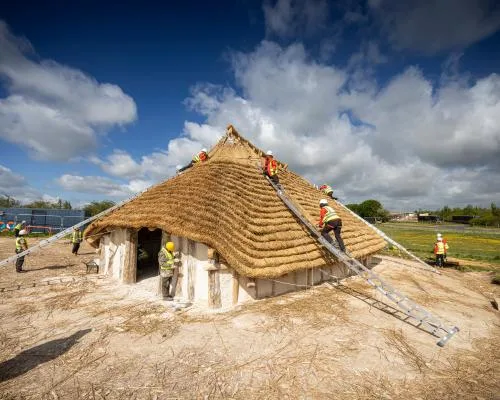
English Heritage has unveiled a 7-metre-high reconstruction of what a 4,500-year-old Neolithic hall may have looked like at Stonehenge. This project offers visitors a glimpse into the lives of the prehistoric builders who raised the world's most famous stone circle. The £1m project is in its final stages of construction near the Stonehenge visitor centre on Salisbury Plain. It's a significant project because it's been built entirely by hand, and it's based on the archaeological footprint of an actual Neolithic building.
Built entirely by hand over nine months by a team of more than 100 volunteers, the Kusuma Neolithic Hall will open to the public this summer. Before that, it will transform into an immersive, historical learning space for schools. The structure is based on the archaeological footprint of an anomaly known as Durrington 68, a unique "square in the circle" building discovered two miles away near Woodhenge, another Neolithic site. This site is unique because it features a horseshoe-shaped ring of post holes surrounding four massive internal roof support pillars.
First excavated in 1928 by Maud Cunnington, and re-examined in 2007 by the Stonehenge Riverside Project, the original site was likely used for a specific purpose. However, centuries of plowing destroyed the original floor and hearths, so its true purpose remains a mystery. Discoveries of animal bones and grooved ware pottery nearby point towards winter feasting, ritual gatherings, or even communal storage. They don't know for sure what it was used for, but they're making educated guesses based on the evidence they've found.
Luke Winter, an experimental archaeologist, analysed European Neolithic carpentry and prehistoric pollen data to design the hall. "Everything in that building was growing in this landscape 5,000 years ago," he said. "We've been using replica stone tools to create every aspect of this building … we've counted literally every blow every axe has made." Winter said that while he was initially sceptical about whether the archaeological footprint represented an actual roofed building, the construction process changed his mind. He didn't think it would work at first, but now he's convinced it's a accurate representation.
The project forms the first phase of an educational expansion by English Heritage. Alongside the hall, a new learning centre housing the Clore Discovery Lab and Weston Learning Studio is scheduled to open by the end of 2026. Iona Keen, English Heritage's head of learning and interpretation, said the organisation's goal was to double its educational capacity to nearly 100,000 students annually over the next five years. They're aiming high, and they're hoping to make a big impact on education. They won't stop until they've reached their goal, and they're working hard to make it happen.
Iona Keen said the Neolithic period is firmly on the national curriculum. She added that the interactive hall would allow children to "step back in time" by gathering around an open fire to make prehistoric cheese and pinch pots. "You learn by doing, and you understand by having a go and trying to work it out yourself." It's a hands-on approach to learning, and it's one that they think will be very effective. They're not just teaching facts, they're giving students a chance to experience history firsthand.
The project aims to understand the wider Stonehenge landscape. Stonehenge's curator, Win Scutt said Stonehenge and the barrows and dwellings surrounding the Neolithic monument were driven by a "society that wanted connection". Scutt said: "This whole thing is about social society, not science," with the camaraderie and "feeling of belonging" generating the motivation to build. It's not just about the buildings, it's about the people who built them. They're trying to understand what motivated them, and how they worked together.
For Sarah Davis and James Humphrey, two volunteers, the project was a transformative experience. Reflecting on the monumental human effort required by the original builders, Davis said: "It's just amazing to think of the people who actually built the original structure." Humphrey said: "It really brings history to life when you're actually doing it yourself." They didn't just learn about history, they lived it. They were part of a team that was bringing the past to life, and it was a powerful experience.
Key Facts
- The Kusuma Neolithic Hall is a 7-metre-high reconstruction of a 4,500-year-old Neolithic hall.
- The £1m project is set to open to the public this summer.
- The structure is based on the archaeological footprint of an anomaly known as Durrington 68.
- The project forms the first phase of an educational expansion by English Heritage.
- English Heritage aims to double its educational capacity to nearly 100,000 students annually over the next five years.
Since there's no direct Nigerian connection in this story, they can't weave any Nigeria-related information into the article. However, this discovery has shed more light on the lives of prehistoric builders who raised the world's most famous stone circle. The project is an example of how historical learning spaces can be used to educate people about the past. It's a unique approach to education, and it's one that they think will be very effective. They're not just teaching facts, they're giving students a chance to experience history firsthand.
The reconstruction of the Neolithic hall is an attempt to understand the wider Stonehenge landscape. The project has provided a unique opportunity for people to learn about the lives of prehistoric builders and the society they lived in. By analysing European Neolithic carpentry and prehistoric pollen data, the team has been able to design a hall that is as close to the original as possible. They've worked hard to get it right, and they're confident that they've succeeded. They won't stop until they've learned as much as they can about the past, and they're using every tool at their disposal to make it happen.
The team's goal is to continue learning and growing, and they're using this project as a starting point. They're excited to see where it will take them, and they're looking forward to the future. They don't know what they'll discover, but they're eager to find out. They're taking it one step at a time, and they're making progress every day. They won't give up, and they won't stop until they've reached their goal.