

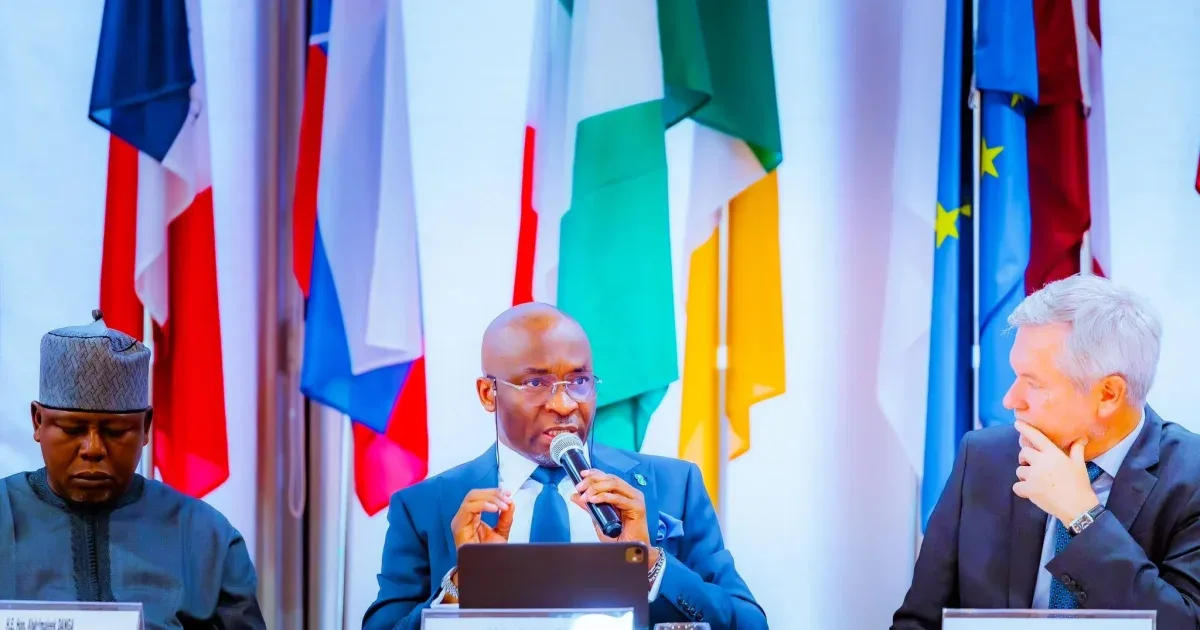
'We have put guardrails in the way the state police are going to be operated. The guardrails will not allow any abuse,' Deputy Speaker Benjamin Kalu said.
Nigeria's Deputy Speaker, Benjamin Kalu, has sought to allay fears over the proposed creation of state police, assuring that the constitutional amendment bill contains sufficient safeguards to prevent abuse. Speaking at a reception hosted by the Ambassador of the European Union to Nigeria and ECOWAS, Kalu, who is also the Chairman of the House Committee on Constitution Review, said the bill responds to legitimate concerns about abuse with architecture, not assurances.
The proposed establishment of state police has remained one of the most contentious constitutional reform issues in Nigeria, with supporters arguing that the country's highly centralised policing structure is no longer adequate to tackle growing insecurity. Critics, however, fear it could be exploited by state governments for political repression.
Kalu argued that Nigeria's size and population make the current arrangement increasingly unsustainable. 'Nigeria is a federation of 923,768 square kilometres, home to more than 230 million people by United Nations estimates, yet it remains policed by a single, centrally commanded force,' Kalu said.
No other federation of our size operates this way; from Germany to India, from Canada to Australia, the world's great federations police locally and coordinate nationally. Kalu said the proposal follows settled wisdom: 'a constitutional framework allowing states to establish their own police services, with defined jurisdictions, independent oversight, professional recruitment standards, and coordinated command.'
The renewed push for state police comes amid sustained calls from governors, security experts, and civil society groups for reforms to Nigeria's security architecture in response to rising cases of banditry, kidnapping, terrorism, and communal violence across different parts of the country.
The Deputy Speaker further urged the European Union to continue supporting the broader constitutional amendment process, describing the exercise as one aimed at strengthening democratic governance and improving service delivery. He disclosed that the constitutional amendment bills have passed both chambers of the National Assembly and are now at the crucial stage of securing approval from at least 24 state Houses of Assembly before they can be transmitted for presidential assent.
Kalu also canvassed support for the Reserved Seats for Women Bill, describing greater female representation in governance as both a democratic necessity and an economic imperative. According to him, women account for 49.3 per cent of Nigeria's population but occupy only 19 of the 469 seats in the National Assembly.
The McKinsey Global Institute estimates that greater female representation in senior roles can lead to a 21 per cent increase in economic growth in Nigeria.
The constitutional amendment bills are at a crucial stage, and Kalu said the continued partnership of the European Union is needed to ensure they pass. 'In this decisive phase, your continued partnership through technical cooperation, comparative expertise, and the candid counsel that only trusted friends can give matters more than ever,' he said.
Nigeria is a federation of 923,768 square kilometres, home to more than 230 million people by United Nations estimates, yet it remains policed by a single, centrally commanded force. This arrangement is increasingly unsustainable, and the proposal for state police follows settled wisdom from other great federations.
The Deputy Speaker further canvassed support for the Reserved Seats for Women Bill, describing greater female representation in governance as both a democratic necessity and an economic imperative. Women account for 49.3 per cent of Nigeria's population but occupy only 19 of the 469 seats in the National Assembly.
The continued push for constitutional reform is aimed at strengthening democratic governance and improving service delivery in Nigeria. The European Union's continued partnership is crucial in this decisive phase.