

The single sharpest fact in one or two punchy sentences. Who did what, where, when, and why it matters. Not a summary of everything — the one thing that makes someone stop scrolling. A reader who only reads this paragraph must understand what happened.
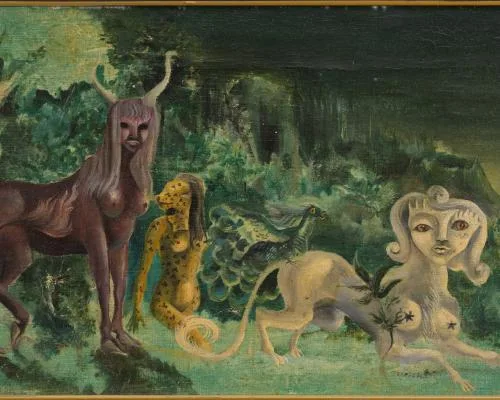
A recently discovered painting by surrealist artist Leonora Carrington, made during her psychiatric confinement in 1940, will go on public display for the first time in London this summer.
You might know Leonora Carrington as a celebrated surrealist artist, feminist icon, and prominent figure in Mexico's art scene. But few people know about her harrowing experience in a Spanish psychiatric hospital, where she was confined for her mental health. During this time, she created two paintings that would become central to her later work, including 'Villa Pilar', which will be displayed for the first time in London.
'Carrington suffered a psychological breakdown in Madrid and was admitted to Sanatorium Morales in Santander, a psychiatric hospital where she underwent traumatic psychiatric treatments that she later described in her memoir 'Down Below,' Vanessa Boni, curator of the exhibition, explained. 'As we know from her memoir, it was really traumatic,' she said. 'Dr. Luis Morales kept the painting his entire life, and when he passed away, it was handed down to his daughter.'
Dr. Morales' family has loaned the painting publicly for the first time, which will join the exhibition 'Leonora Carrington – the Symptomatic Surreal' at the Freud Museum in London. The exhibition, which has been extended until 10 August, marks a significant moment in Carrington's journey.
To understand Carrington's story better, it's essential to know about her early life. Born into a wealthy Lancashire family in 1917, Carrington rebelled against the expectations placed on upper-class women. She studied at the Chelsea School of Art before meeting her future partner, Max Ernst, at a dinner party in London in 1937.
In 2011, one of her paintings was auctioned for £22.5m, a record for a UK-born female artist. While living in New York, Carrington gave her Santander sketchbooks to the surrealist collector Julien Levy, whose collection was sold at auction and dispersed into private collections in 2004.
Daniel Vega Pérez de Arlucea, director of Faro Santander, said, 'This is not simply a matter of showcasing the work of one of the most important surrealist artists, but of recognising and revisiting a chapter of her life deeply rooted in this city.'
As 'Villa Pilar' is revealed, art enthusiasts and fans of Carrington will be eager to see how her past experiences influenced her work. With this exhibition, the public will get a chance to learn more about Carrington's life and art, both during her confinement and after.
The exhibition 'Leonora Carrington – the Symptomatic Surreal' will be on display until 10 August at the Freud Museum in London, before moving to Faro Santander in September.
Key Facts
- Leonora Carrington, a surrealist artist, was confined in a Spanish psychiatric hospital in 1940.
- She created 'Villa Pilar' during her time in hospital, which will be displayed for the first time in London.
- The painting will join the exhibition 'Leonora Carrington – the Symptomatic Surreal' at the Freud Museum in London.
- The exhibition has been extended until 10 August.
- Carrington's painting was auctioned for £22.5m in 2011, a record for a UK-born female artist.
'As we know from her memoir, it was really traumatic,' Vanessa Boni said. 'Dr. Morales kept the painting his entire life, and when he passed away, it was handed down to his daughter.'
Carrington's story is a powerful example of how art can transcend even the darkest of experiences. Her work has inspired countless artists and continues to captivate audiences today. With 'Villa Pilar' on display, art lovers will get a glimpse into Carrington's life and art, offering a new perspective on her work and legacy.