

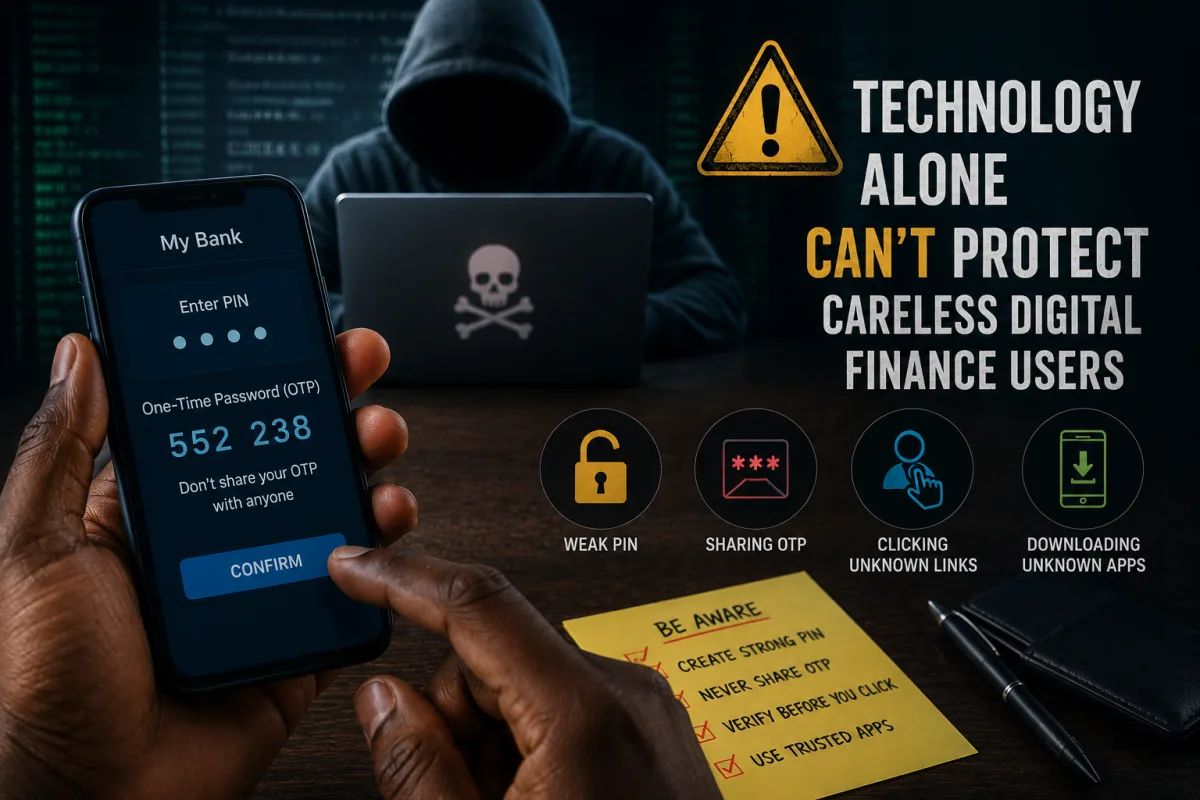
Ghana’s digital payment ecosystem is expanding fast, but fraud cases are on the rise, with banks losing millions to digital scams.
The Ghana Association of Banks (GAB) says technology alone cannot protect careless digital finance users who expose their passwords, PINs, ATM cards, phones, and account details to fraudsters. The Association’s CEO, John Awuah, said banks have invested heavily in cybersecurity infrastructure, but customers must also take responsibility for protecting themselves.
“Banks have invested heavily in cyber-security infrastructure. But what can systems do if the people using them remain vulnerable? That is why users themselves are a critical part of the security chain,” Awuah explained.
According to the Bank of Ghana’s 2024 Payment Systems Oversight Annual Report, Ghana’s payment landscape remained “buoyant and robust” in 2024 as adoption of digital payments increased. The central bank said it focused on effective oversight of players within the space to keep risks associated with digital payments at a minimum.
But fraud exposure has also remained a major concern. The Bank of Ghana’s 2024 fraud report covers attempted and successful fraudulent activities recorded by banks, specialized deposit-taking institutions, and payment service providers from January to December 2024.
For payment service providers, the Ghana Association of Banks’ overview of the report shows that fraud cases rose by seven percent to 15,673 in 2024, while the value at risk increased by 18 percent to approximately GH¢19 million.
“A lot of fraud has moved away from the traditional “break and enter” environment, where criminals physically attacked bank branches. Now, fraud is increasingly moving into the digital arena. We are seeing ATM fraud, card fraud, digital banking fraud, mobile, and electronic payment fraud,” Awuah said.
The Association of Banks CEO said banks are seeing fraud move into digital channels because customers are increasingly using mobile platforms, internet banking, cards, and electronic payments. He further indicated that banks have invested aggressively in digital channels to make financial services easier and faster for customers, but every new layer of convenience introduces new risks.
“What can systems do if the people using them remain vulnerable? That is why users themselves are a critical part of the security chain,” Awuah explained.
He said once another person gains access to a customer’s device, the risk can spread across several financial channels.
“Once somebody gains access to your device, they may gain access to your internet banking, your passwords, your mobile wallet, and your financial information. People must understand that once they choose to operate within the digital financial space, they also have a responsibility to protect themselves,” he said.
The thought-leadership platform, an initiative of Hubtel, will air on JoyNews and Joy FM on Wednesday, July 22, 2026, at 8 p.m. The forum will bring together regulators, banks, fintech companies, payment service providers, telecommunications firms, cybersecurity experts, businesses, and consumers to examine how fraud is affecting confidence in Ghana’s digital economy.
A lot of digital fraud involves some level of customer complicity or vulnerability, Mr. Awuah said. He said people write down PINs, store passwords on phones, share ATM cards, and give access details to others.
Fraudsters call customers pretending to be bank officials, claim that systems are being updated, and ask them to click links or provide information. They also use fake emails that appear legitimate at first glance, Mr. Awuah said.
Ghana’s payment landscape remained buoyant and robust in 2024 as adoption of digital payments increased. Payment service providers processed about 8.1 billion transactions valued at approximately GH¢3 trillion in 2024, underscoring the scale of activity now flowing through digital channels.
Key Facts
- The Bank of Ghana’s 2024 Payment Systems Oversight Annual Report states that Ghana’s payment landscape remained “buoyant and robust” in 2024 as adoption of digital payments increased.
- The Ghana Association of Banks’ overview of the report shows that fraud cases rose by seven percent to 15,673 in 2024.
- The value at risk increased by 18 percent to approximately GH¢19 million.
- Payment service providers processed about 8.1 billion transactions valued at approximately GH¢3 trillion in 2024.
- The central bank said it focused on effective oversight of players within the space to keep risks associated with digital payments at a minimum.